


What Is Marketplace Software? (Complete Guide for Founders in 2026)

Quick Answer
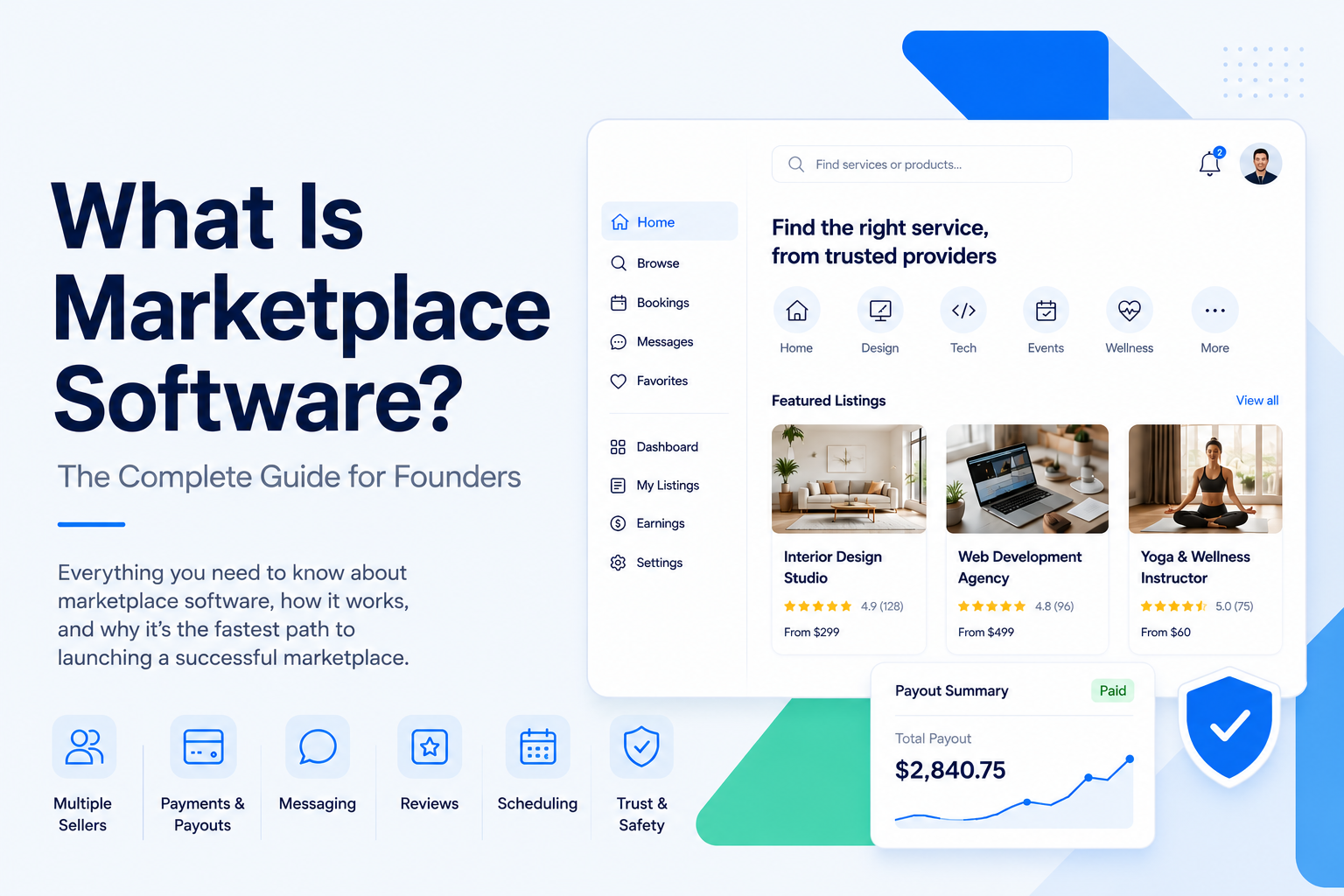
Marketplace software is a platform designed to power online marketplaces where multiple buyers and sellers interact, communicate, and complete transactions. Unlike traditional website builders or ecommerce platforms, marketplace software includes marketplace-specific functionality such as multi-vendor listings, payment splitting, messaging, reviews, user permissions, scheduling, commissions, and marketplace administration.
TL;DR
- Marketplace software is purpose-built for two-sided and multi-vendor marketplaces.
- It includes marketplace infrastructure that would otherwise take months to custom build.
- Good marketplace software helps founders launch quickly and focus on customers instead of technology.
- Most startups should begin with marketplace software rather than custom development.
- Tangram has helped launch more than 500 marketplaces, and we've consistently found that faster launches lead to faster learning and better businesses.
What Is Marketplace Software?
Marketplace software is a specialized software platform that enables multiple independent buyers and sellers to transact within the same application.
Unlike a traditional ecommerce website, where one business sells directly to customers, marketplace software allows many businesses or individuals to list products or services while the platform facilitates discovery, payments, communication, reviews, and trust.
Common examples include:
- Airbnb
- Uber
- Etsy
- Fiverr
- Upwork
- Turo
- Thumbtack
Although these marketplaces serve different industries, they all rely on similar marketplace infrastructure behind the scenes.
What Makes Marketplace Software Different?
Traditional websites manage one business.
Marketplace software manages relationships between many businesses.
Instead of one store owner selling products, marketplace software must coordinate multiple independent participants.
This creates significantly more complexity.
For example, marketplace software typically manages:
- Multiple user roles
- Listings
- Search
- Messaging
- Reviews
- Marketplace commissions
- Stripe Connect payment splitting
- Vendor payouts
- Notifications
- Scheduling
- Bookings
- User permissions
- Marketplace moderation
These aren't simply website features.
They're marketplace infrastructure.
Marketplace Software vs Ecommerce Software
Many first-time founders assume Shopify or WooCommerce can become marketplace software.
While technically possible, they're solving different problems.
An ecommerce platform helps one business sell.
Marketplace software helps many businesses transact.
What Is a Two-Sided Marketplace?
A two-sided marketplace connects two distinct user groups.
For example:
The software sits in the middle, creating value for both sides.
As more sellers join, buyers gain more choice.
As more buyers join, sellers gain more opportunity.
This creates marketplace network effects.
How Marketplace Software Works
Every marketplace follows roughly the same workflow.
- Sellers create accounts.
- Sellers publish listings.
- Buyers discover listings.
- Buyers communicate with sellers.
- Transactions occur.
- Payments are processed.
- Reviews build trust.
- Repeat transactions strengthen the marketplace.
Although industries differ, these core workflows remain remarkably similar.
Common Types of Marketplace Software
Marketplace software can support many business models.
Service Marketplace Software
Examples:
- Cleaning
- Tutoring
- Legal services
- Beauty & wellness
- Home services
Rental Marketplace Software
Examples:
- Vacation rentals
- Equipment rentals
- Vehicle rentals
- Event rentals
Product Marketplace Software
Examples:
- Handmade goods
- Vintage products
- Wholesale products
- Local marketplaces
Talent Marketplace Software
Examples:
- Freelancers
- Consultants
- Agencies
- Contractors
B2B Marketplace Software
Examples:
- Manufacturers
- Distributors
- Enterprise procurement
- Supplier networks
C2C Marketplace Software
Examples:
- Peer-to-peer marketplaces
- Local resale
- Collectibles
- Community marketplaces
Our Experience Launching 500+ Marketplaces
After helping launch marketplaces across industries ranging from education to aircraft sales, we've noticed something interesting.
The biggest technical challenges are surprisingly consistent.
Founders usually need:
- Payments
- Reviews
- Messaging
- Scheduling
- Authentication
- Search
- Notifications
Yet many spend months rebuilding these systems before acquiring a single customer.
Our biggest lesson has been:
Marketplace founders shouldn't spend their time building marketplace infrastructure.
They should spend their time building marketplace businesses.
Why Marketplace Software Matters
Marketplace software isn't valuable because it saves developers time.
It's valuable because it saves founders time.
Every week spent rebuilding infrastructure is a week not spent:
- Recruiting sellers
- Talking to buyers
- Improving onboarding
- Refining pricing
- Testing marketing
- Building network effects
The faster founders can validate their marketplace, the greater their chances of success.
Should You Build Your Marketplace From Scratch?
Usually, no.
Custom development makes sense when:
- Your workflows are highly specialized.
- Existing marketplace software genuinely cannot support your business.
- You already have an experienced engineering team.
- Technology itself is your competitive advantage.
For most startups, marketplace software provides a significantly faster path to launch.
Marketplace Software vs AI Marketplace Builders
AI has transformed software development.
Modern AI builders can generate applications in minutes.
However, marketplace applications involve considerably more business logic than traditional websites.
Marketplace workflows include:
- Payment splitting
- Vendor approvals
- User permissions
- Messaging
- Scheduling
- Reviews
In our experience, AI produces the best results when paired with marketplace expertise rather than used entirely independently.
Human review remains an important part of building production-ready marketplace software.
The Biggest Mistake Founders Make
The biggest mistake isn't choosing the wrong software.
It's believing software is the product.
Successful marketplace founders focus on:
- Customers
- Liquidity
- Trust
- Supply
- Demand
- Marketing
Software simply enables those things.
How to Choose Marketplace Software
When comparing platforms, evaluate:
- Speed to launch
- Marketplace functionality
- Scalability
- Design flexibility
- AI capabilities
- Human support
- API extensibility
- Total cost of ownership
- SEO
- Mobile readiness
Don't choose based solely on monthly pricing.
Choose based on how quickly the platform helps you build a successful business.
Frequently Asked Questions
Final Thoughts
Marketplace software has never been more accessible.
AI, modern APIs, and marketplace-specific platforms have dramatically reduced the time required to launch.
The founders who succeed won't necessarily be the ones who build the most sophisticated software.
They'll be the ones who launch, learn, and improve the fastest.
After helping launch more than 500 online marketplaces, we've consistently found that success comes from talking to customers—not endlessly rebuilding infrastructure.
If you're evaluating platforms, we recommend also reading our comprehensive guide:
How to Choose the Best Marketplace Software (2026 Buyer's Guide)
It compares today's leading marketplace platforms, explores hidden costs, and provides a practical framework for choosing the right software for your marketplace.
Get notified of new features & resources.
Subscribe to our newsletter and stay up-to-date on our roadmap, new features, and free resources to help you scale your marketplace.
%2020.39.51%201%20(1).png)
%2020.39.51%202%20(2).png)
%2020.39.51%204%20(2).png)
%2020.39.51%203%20(1).png)
.png)