


How to Choose the Best Marketplace Software in 2026 (Complete Buyer's Guide)


Quick Answer
The best marketplace software is the platform that lets you launch quickly, validate your business with real customers, and scale without forcing you to rebuild your marketplace from scratch. While every founder's needs are different, most marketplaces benefit from software that already includes essential infrastructure like payment splitting, user authentication, messaging, reviews, scheduling, and API integrations—allowing founders to spend their time growing supply and demand instead of managing developers.
TL;DR
If you only remember one thing from this guide, remember this:
- The best marketplace software isn't the one with the most features—it's the one that gets you to market the fastest without limiting your future growth.
- Most founders spend far too much time building software instead of validating demand.
- Marketplace-specific platforms almost always outperform generic website builders and AI app builders for two-sided marketplaces.
- Custom development should be reserved for businesses with truly unique requirements and the engineering resources to support them.
- AI is dramatically reducing development time, but it works best when combined with experienced human review rather than relying solely on AI-generated code.
- Based on our experience launching more than 500 online marketplaces, founders who launch earlier and iterate with customer feedback consistently outperform founders who spend months perfecting an MVP.
Why Choosing Marketplace Software Matters
Choosing marketplace software is one of the highest-impact decisions you'll make as a marketplace founder.
The platform you choose determines how quickly you can launch, how much you'll spend over the next several years, how easily you can adapt to customer feedback, and whether your technology becomes a competitive advantage—or an expensive bottleneck.
We've seen founders spend tens of thousands of dollars custom-building marketplace features that already exist in specialized marketplace software. We've also seen founders lose months trying to stitch together generic website builders, automation tools, and AI-generated code that were never designed for marketplace businesses.
The reality is that software rarely determines whether a marketplace succeeds.
Execution does.
The faster you can validate your business model, onboard buyers and sellers, and improve based on real customer feedback, the greater your chances of building a successful marketplace.
That's why choosing the right software isn't really a technology decision.
It's a business strategy decision.
Why Trust This Guide?
Unlike many marketplace software comparison articles, this guide isn't written by a general software reviewer.
It's based on real-world experience helping founders launch marketplaces across dozens of industries.
Over the past several years, Tangram has helped launch 500+ online marketplaces, including businesses in:
- Beauty & Wellness
- Education
- Legal Services
- Home Services
- Freelancing
- Events
- Rentals
- Aircraft Sales
- Professional Services
- Local Marketplaces
- B2B Marketplaces
- And many more
Working with hundreds of founders has revealed consistent patterns.
The biggest challenge is almost never choosing the perfect technology.
It's avoiding months of unnecessary development so founders can focus on acquiring customers, validating demand, and building network effects.
Throughout this guide, we'll share practical lessons we've learned helping marketplace founders avoid expensive mistakes, launch faster, and build software that grows alongside their business.
What You'll Learn
By the end of this guide you'll understand:
- How to evaluate marketplace software platforms beyond feature lists.
- When to choose a marketplace platform versus custom marketplace software development.
- The pros and cons of AI marketplace builders, no-code marketplace builders, and traditional marketplace software.
- The hidden costs that most founders overlook.
- Which platforms are best suited for service marketplaces, rental marketplaces, B2B marketplaces, C2C marketplaces, and other two-sided marketplace business models.
- How to avoid spending months building features that already exist.
- A practical decision framework for choosing the right marketplace software for your business.
Whether you're building a service marketplace, multi-vendor marketplace, rental marketplace, talent marketplace, B2B marketplace, C2C marketplace, or another two-sided marketplace, the principles in this guide will help you make a more informed decision.
The Biggest Lesson We've Learned After 500+ Marketplace Launches
If there's one lesson we've learned from helping launch hundreds of marketplaces, it's this:
Marketplace founders shouldn't spend their time building marketplace infrastructure—they should spend their time building marketplace businesses.
Too many founders assume they need to custom-build everything from scratch.
In reality, the features that consume the most development time—payment splitting, user authentication, permissions, messaging, scheduling, reviews, notifications, and transaction management—are rarely what make a marketplace successful.
Customers don't choose Airbnb because of its login screen.
They choose it because of its supply, trust, brand, and experience.
The same principle applies to nearly every marketplace.
Your competitive advantage is your niche, your community, your customer experience, and your ability to solve a real problem—not rebuilding infrastructure that has already been solved.
The best marketplace software allows you to launch quickly, iterate continuously, and spend your limited time where it creates the greatest return: growing your marketplace.
What Is Marketplace Software?
Marketplace software is a specialized platform for building two-sided marketplaces where buyers and sellers interact, complete transactions, communicate, and leave reviews—all within a single application.
Unlike a traditional website builder or ecommerce platform, marketplace software manages multiple user roles, payments between parties, marketplace commissions, listings, messaging, scheduling, and trust systems.
Examples include:
- Service marketplaces
- Product marketplaces
- Rental marketplaces
- Freelancer marketplaces
- B2B marketplaces
- C2C marketplaces
- Event marketplaces
- Talent marketplaces
Well-known marketplace businesses like Airbnb, Etsy, Uber, Fiverr, and Upwork all rely on marketplace-specific functionality that goes far beyond what a normal website builder provides.
If you're building a marketplace, choosing software designed specifically for marketplaces will almost always save significant time, money, and technical complexity compared to adapting generic tools.
What Is a Two-Sided Marketplace?
A two-sided marketplace (also called a multi-vendor marketplace) connects two distinct groups of users that create value for one another.
Usually these groups are:
- Buyers ↔ Sellers
- Clients ↔ Freelancers
- Renters ↔ Owners
- Students ↔ Teachers
- Patients ↔ Providers
- Employers ↔ Candidates
The marketplace platform sits in the middle and manages everything from discovery and transactions to communication and trust.
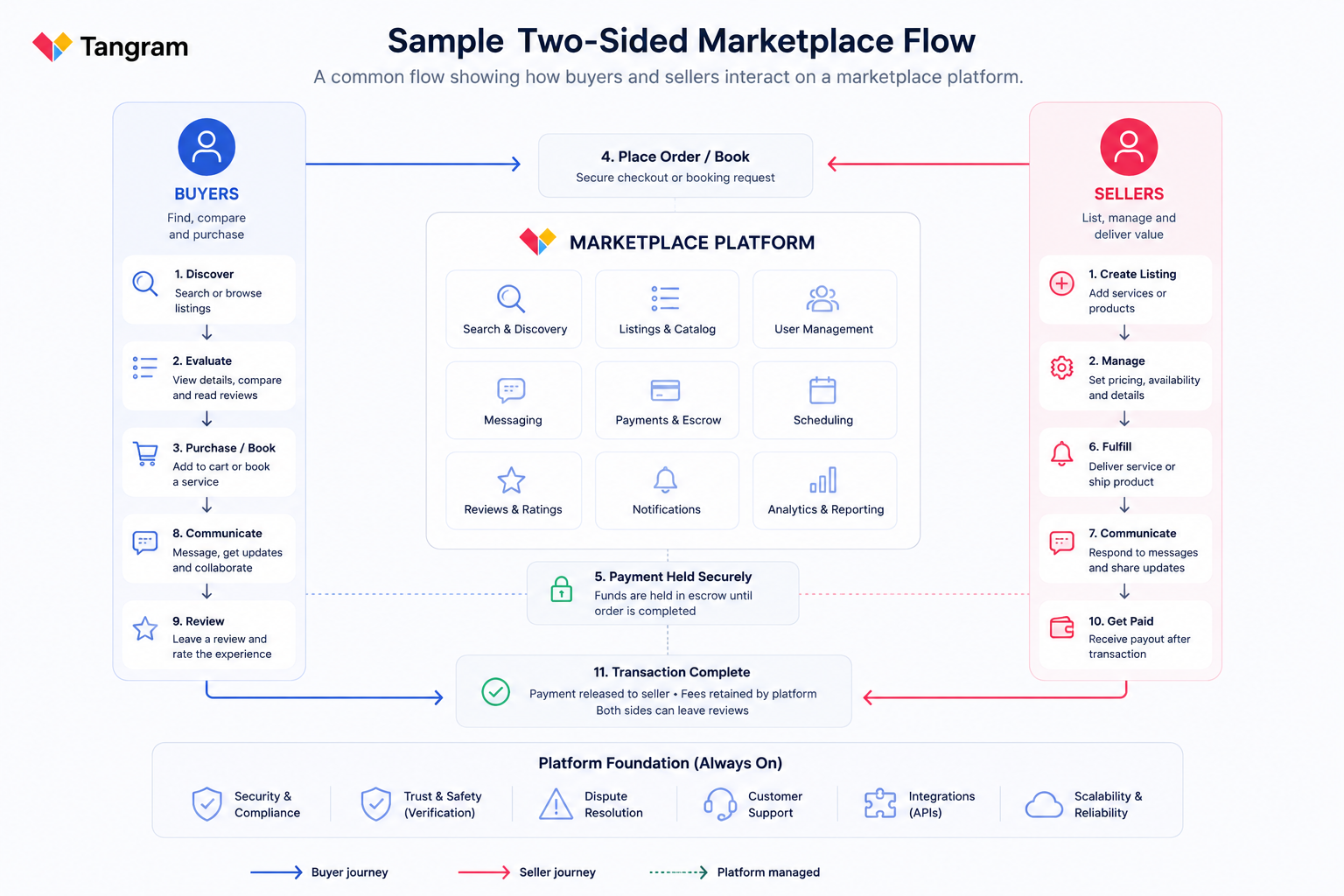
As your marketplace grows, every new buyer increases value for sellers, and every new seller increases value for buyers.
This creates what economists call network effects, one of the primary reasons successful marketplaces become difficult to compete against.
Marketplace Software vs Website Builders
One of the biggest misconceptions we see is founders assuming any website builder can become a marketplace.
Technically, almost anything is possible with enough development time.
Practically, the cost and complexity can increase dramatically.
Generic website builders work well for:
- Company websites
- Portfolios
- Landing pages
- Blogs
- Small ecommerce stores
Marketplace software is built specifically for businesses where users transact with one another rather than directly with you.
Marketplace Software vs AI Marketplace Builders
AI has dramatically changed how founders build software.
Today, you can generate applications using AI prompts in minutes.
That sounds exciting—and in many ways it is.
However, marketplace software presents challenges that generic AI app builders often struggle with.
Marketplace applications involve significantly more complexity than traditional websites because they require:
- Multiple user roles
- Payment splitting
- Marketplace commissions
- Review systems
- User verification
- Messaging
- Scheduling
- Transaction management
- Notifications
- Permissions
- Dispute workflows
These aren't just interface problems—they're business logic problems.
While AI can accelerate development considerably, we've found that the best outcomes happen when AI generation is paired with experienced human review.
Without that review, founders often find themselves trapped in an endless cycle of prompts trying to fix one issue only to introduce another.
As AI continues improving, we expect it to become an increasingly valuable tool for marketplace founders—but today, human expertise still plays an important role in producing reliable, production-ready marketplace applications.
Marketplace Software vs Custom Development
Many founders assume they need custom software from day one.
In reality, custom development should be reserved for businesses with requirements that existing marketplace platforms genuinely cannot support.
For most startups, the question isn't whether custom development is possible.
It's whether rebuilding existing marketplace infrastructure creates enough business value to justify the additional cost and time.
Consider everything that already needs to exist before a marketplace can launch:
- User authentication
- User permissions
- Marketplace listings
- Search and filtering
- Messaging
- Reviews
- Stripe payment splitting
- Payouts
- Notifications
- Scheduling
- Booking workflows
- Admin moderation
- Analytics
- APIs
Rebuilding these systems from scratch often takes months—and sometimes years.
Unless these features are your competitive advantage, most founders benefit from starting with proven marketplace infrastructure and customizing only where it creates unique value.
The Four Types of Marketplace Software
Not all marketplace software is built for the same purpose.
Understanding these categories can save you from choosing the wrong platform.
1. Marketplace-Specific Platforms
Examples:
- Tangram
- Sharetribe
- Arcadier
Best for:
Founders who want marketplace functionality built in from day one.
Pros
- Marketplace features included
- Faster launch
- Lower development costs
- Marketplace payment workflows
- User roles already implemented
Cons
- Each platform offers different levels of flexibility.
- Some platforms require expensive custom development for advanced customization.
2. No-Code Marketplace Builders
Examples:
- Softr
- Glide (with limitations)
- Airtable-based solutions
Best for
Simple directories and lightweight MVPs.
Pros
- Easy to learn
- Fast setup
- Low monthly cost
Cons
- Limited marketplace functionality
- Limited customization
- Scaling challenges
- Often requires connecting multiple third-party tools
3. AI Marketplace Builders
Examples:
- Lovable
- Durable
Best for
Rapid prototyping and experimentation.
Pros
- Extremely fast interface generation
- Strong design flexibility
- Good for validating ideas
Cons
- Marketplace business logic often requires significant additional work
- Production readiness varies
- Human review is still important
4. Custom Marketplace Development
Best for:
- Enterprise businesses
- Highly specialized workflows
- Existing engineering teams
- Complex integrations
Pros
- Unlimited flexibility
- Complete ownership
- Fully customized experience
Cons
- Highest cost
- Longest development timeline
- Ongoing maintenance responsibility
- Increased technical risk
Our Experience
After helping launch more than 500 online marketplaces, we've noticed something surprising:
Founders almost never regret launching too early.
They frequently regret launching too late.
We've seen founders spend six months perfecting software while talking to almost no customers.
We've also seen founders launch with a simpler MVP, gather feedback immediately, refine their marketplace based on real usage, and grow much faster.
The software itself wasn't what determined success.
The speed at which they learned from the market did.
That's why, throughout the rest of this guide, we'll focus less on individual features and more on helping you choose software that enables rapid learning, customer validation, and long-term scalability.
How to Choose the Best Marketplace Software: A 20-Point Evaluation Framework
If you've searched for the best marketplace software, you've probably noticed that every platform claims to be the fastest, easiest, or most flexible.
The problem is that most comparison articles evaluate software based on feature lists rather than what actually determines whether your marketplace succeeds.
In our experience helping launch 500+ online marketplaces, founders rarely regret choosing a platform that has one less feature.
They frequently regret choosing software that:
- Takes too long to launch.
- Costs far more than expected.
- Can't adapt as their marketplace evolves.
- Forces them into expensive custom development.
- Prevents them from focusing on acquiring customers.
Instead of asking "Which platform has the most features?", ask:
"Which platform gives me the highest probability of launching quickly and building a successful marketplace?"
That shift in thinking changes everything.
The 20 Criteria Every Founder Should Evaluate
We recommend scoring every marketplace platform across these 20 areas.
The Five Criteria That Matter Most
While every criterion is important, we've found these five have the biggest long-term impact.
1. Speed to Launch
Nothing replaces customer feedback.
Every month spent building instead of launching delays learning, revenue, and network effects.
Ask yourself:
How quickly can I onboard my first 100 users?
Not:
How quickly can I finish my software?
2. Marketplace Functionality
Marketplace software isn't just another website.
It needs to support workflows that don't exist in traditional website builders.
Core functionality should include:
- User authentication
- Multiple user roles
- Listings
- Messaging
- Reviews
- Stripe payment splitting
- Scheduling
- Notifications
- Admin moderation
- Search & filtering
The more of these that already exist, the less time you'll spend reinventing infrastructure.
3. Total Cost of Ownership
Monthly pricing is rarely the biggest expense.
The true cost includes:
- Developer time
- Maintenance
- Third-party subscriptions
- Opportunity cost
- Migration costs
- Custom feature development
- Time spent managing technical work
A platform with a higher monthly subscription can easily become the less expensive option if it saves months of development.
4. Scalability
Your MVP isn't your final product.
The best marketplace software allows you to:
- Launch quickly
- Validate demand
- Add features over time
- Handle increasing transaction volume
- Integrate with new tools
- Expand into mobile applications
Founders often underestimate how quickly marketplace requirements evolve.
5. Founder Time
This is the criterion almost nobody discusses.
Every hour spent debugging software is an hour not spent:
- Recruiting sellers
- Finding buyers
- Improving retention
- Building partnerships
- Talking to customers
- Refining pricing
The best marketplace software maximizes founder leverage.
The Three Most Overlooked Evaluation Criteria
1. Founder Time
Most comparison articles focus on features.
Very few ask:
How much work does this create for me?
Your time is your most limited startup resource.
Choose software that lets you spend more time growing your marketplace—not managing developers.
2. Opportunity Cost
Waiting six additional months to launch doesn't just delay revenue.
It delays:
- Customer interviews
- Product-market fit
- Referrals
- SEO growth
- Marketplace liquidity
- Investor traction
In fast-moving industries, delayed execution can become your biggest expense.
3. Human Expertise
AI is becoming an incredible accelerator.
But AI still benefits from human oversight.
Marketplace software includes complex workflows involving:
- Payments
- Permissions
- Messaging
- Scheduling
- Reviews
- Transactions
Having access to marketplace experts who understand these workflows can save weeks—or months—of trial and error.
The Biggest Mistake Founders Make
The biggest mistake isn't choosing the wrong software.
It's believing software is the business.
Your marketplace succeeds because of:
- Great supply
- Happy customers
- Strong retention
- Effective marketing
- Network effects
- Continuous iteration
Software simply enables those outcomes.
We've seen founders spend six months perfecting their platform before talking to real customers.
We've also seen founders launch in weeks, collect feedback immediately, and improve their marketplace with every new user.
The second group almost always learns faster.
And in marketplaces, learning faster usually beats building longer.
Decision Framework
If you're still unsure which type of platform is right for you, use this framework.
Choose Marketplace Software if...
- You want to launch within weeks rather than months.
- Your competitive advantage isn't rebuilding infrastructure.
- You want built-in marketplace functionality.
- You want to validate your business before investing heavily in engineering.
- You expect to iterate frequently based on customer feedback.
Choose Custom Development if...
- Your marketplace requires highly specialized workflows unavailable in existing platforms.
- You already have an experienced engineering team.
- You have the budget for long-term maintenance.
- Technology itself is your competitive advantage.
Choose an AI Marketplace Builder if...
- You're rapidly exploring ideas.
- You're comfortable reviewing AI-generated work.
- You're building prototypes rather than production software.
- You understand that marketplace-specific functionality may still require additional development.
Choose a No-Code Platform if...
- Your marketplace is relatively simple.
- You don't require complex payment workflows.
- You primarily need directories, listings, or lightweight internal tools.
- You accept that future customization may become more difficult.
Key Takeaway
The right marketplace software doesn't simply reduce development time.
It increases the amount of time you can spend doing the work that actually grows a marketplace.
That distinction often determines whether founders launch, learn, and scale—or spend months rebuilding infrastructure before they ever acquire their first customer.
Marketplace Software Comparison
Every marketplace platform has strengths and trade-offs.
The "best" marketplace software depends on your budget, timeline, technical experience, and long-term goals.
Some platforms prioritize flexibility.
Others prioritize speed.
Some are excellent for prototypes but struggle with real marketplace functionality.
Others include powerful marketplace infrastructure but require expensive developers for customization.
Rather than recommending one platform for everyone, we recommend understanding where each platform performs well—and where it doesn't.
At a Glance
Marketplace Software Comparison Table
Scoring Methodology
Scores are based on Tangram's experience helping launch more than 500 online marketplaces across a wide range of industries. They are intended to help founders understand relative trade-offs rather than serve as objective benchmarks.
Tangram
Best For
Founders who want to launch quickly without sacrificing design flexibility or marketplace functionality.
Pros
- Marketplace-specific from day one
- AI-assisted development with human review
- Excellent launch speed
- Modern design flexibility
- Strong marketplace infrastructure
- APIs for future customization
- Built-in payments, messaging, scheduling, reviews, permissions, and more
Cons
- Not ideal if your organization already has a large engineering team committed to building everything from scratch.
- Some enterprises with highly specialized workflows may still require additional custom development.
Sharetribe
Best For
Founders building a straightforward marketplace who prioritize proven marketplace functionality over design flexibility.
Pros
- Mature marketplace platform
- Strong marketplace workflows
- Large developer ecosystem
- Reliable infrastructure
Cons
- Limited visual customization out of the box.
- Advanced customization often requires hiring developers.
- No AI-assisted page generation.
Arcadier
Best For
Businesses looking for a traditional marketplace platform with standard functionality.
Pros
- Marketplace-specific platform
- Multi-vendor support
- Established product
Cons
- Less flexible than newer platforms.
- Smaller ecosystem.
- More limited customization.
- Slower innovation.
Bubble
Best For
Founders building custom web applications that happen to include marketplace features.
Pros
- Flexible application builder
- Large community
- Extensive plugin ecosystem
Cons
- Not built specifically for marketplaces.
- Significant configuration required.
- Complex marketplace workflows often require substantial custom work.
- Steeper learning curve than marketplace-specific platforms.
Softr
Best For
Directories, internal tools, and lightweight marketplace MVPs.
Pros
- Fast setup
- Easy to learn
- Affordable
Cons
- Limited marketplace functionality.
- Basic payment capabilities.
- Limited scalability for larger marketplaces.
- Often requires multiple third-party services.
Lovable & Durable
Best For
Rapid experimentation and interface prototyping.
Pros
- Impressive AI-generated interfaces.
- Fast idea validation.
- Strong visual flexibility.
Cons
- Marketplace business logic remains challenging.
- AI-generated applications often require additional debugging.
- Limited built-in marketplace workflows.
- Production readiness varies depending on project complexity.
Custom Marketplace Development
Best For
Companies with unique technical requirements and experienced engineering teams.
Pros
- Unlimited flexibility.
- Complete ownership.
- Fully custom workflows.
- No platform limitations.
Cons
- Highest upfront investment.
- Longest launch timeline.
- Ongoing maintenance responsibility.
- Significant engineering overhead.
- Higher technical risk.
Which Marketplace Software Is Right for You?
Choose Tangram if...
- You want to launch within weeks.
- You want marketplace-specific functionality built in.
- You value AI-assisted development with human expertise.
- You want flexibility without rebuilding infrastructure.
Choose Sharetribe if...
- You need a proven marketplace platform.
- Your marketplace is relatively straightforward.
- You're comfortable hiring developers for advanced customization later.
Choose Softr if...
- You're primarily building a directory.
- Marketplace transactions aren't central to your business.
Choose Lovable or Durable if...
- You're validating ideas quickly.
- You understand you'll likely need additional work before production.
Choose Custom Development if...
- Technology itself is your competitive advantage.
- You have a dedicated engineering team.
- Existing marketplace software genuinely cannot support your business model.
Key Takeaway
No marketplace platform is perfect for every founder.
The right choice depends on balancing speed, cost, marketplace functionality, and future flexibility.
From our experience helping launch hundreds of marketplaces, founders who choose software that minimizes technical overhead are able to spend more time acquiring users, refining their marketplace, and building network effects—the activities that ultimately determine long-term success.
The 10 Biggest Marketplace Software Mistakes Founders Make
Choosing the wrong marketplace software rarely kills a business overnight.
Instead, founders slowly lose time, money, momentum, and confidence while trying to work around limitations that could have been avoided from the beginning.
After helping launch more than 500 online marketplaces, we've noticed the same mistakes appear again and again.
Fortunately, they're also some of the easiest to avoid.
1. Spending Too Much on Software Before Validating Your Marketplace
The biggest mistake isn't choosing the wrong platform.
It's spending too much money before you've proven people actually want your marketplace.
Many founders invest thousands—or even tens of thousands—of dollars building software before they've acquired a single customer.
The reality is simple:
A marketplace with customers can always improve its software.
A marketplace with perfect software but no customers rarely survives.
How to avoid it
Choose software that allows you to:
- Launch quickly
- Validate demand
- Generate revenue
- Improve continuously
Remember:
Your first version isn't your final version.
2. Waiting Too Long to Launch
Every month spent building is a month not spent learning.
One of the most common patterns we've observed is founders believing they need to launch with every feature completed.
In reality, most successful marketplaces evolve dramatically after launch.
Customer feedback almost always changes the roadmap.
The faster you can collect that feedback, the faster you improve.
Ask yourself:
Would you rather launch:
- An 85% complete marketplace in 30 days?
Or
- A 100% complete marketplace six months from now?
For most founders, the first option produces better long-term outcomes.
3. Hiring Developers Without Marketplace Experience
Not all developers understand marketplace businesses.
Marketplace applications involve unique challenges such as:
- Payment splitting
- Vendor payouts
- User permissions
- Multi-role authentication
- Reviews
- Messaging
- Scheduling
- Commission logic
Developers who primarily build traditional websites often underestimate how much infrastructure marketplaces require.
The result can be months of development before discovering critical workflows still don't function correctly.
Before hiring anyone, ask:
- Have they built marketplaces before?
- Can they explain marketplace payment flows?
- Do they understand two-sided marketplaces?
- Have they worked with Stripe Connect or similar payout systems?
Experience matters.
4. Building Instead of Selling
This is perhaps the most expensive mistake of all.
Building software feels productive.
Selling is uncomfortable.
So founders often continue improving the product instead of finding customers.
Unfortunately...
No amount of software development creates marketplace liquidity.
That only happens through:
- Customer conversations
- Outreach
- Partnerships
- Marketing
- Sales
The sooner you begin onboarding users, the sooner your marketplace becomes valuable.
5. Waiting Too Long to Monetize
Many founders delay monetization because they assume growth should come first.
While every marketplace is different, introducing monetization early often helps validate your business model.
Whether you charge:
- Commissions
- Subscription fees
- Listing fees
- Lead generation fees
Understanding what customers will actually pay is one of the most valuable lessons you can learn.
6. Not Talking to Customers Continuously
Your roadmap should come from customers—not assumptions.
Every conversation teaches you something:
- Which features matter.
- Which don't.
- Why users abandon onboarding.
- What prevents transactions.
- What customers are willing to pay for.
Marketplace software should make iteration easy.
But only customers can tell you what to iterate.
7. Building Features for One Customer
Every founder eventually hears:
"If you just added this one feature..."
Sometimes that's true.
Often it isn't.
One customer's request doesn't necessarily represent your marketplace.
Instead of asking:
"Who asked for this?"
Ask:
"How many future customers benefit from this?"
The best roadmap improves the experience for the majority of users—not the loudest users.
8. Ignoring Marketplace Metrics
Marketplaces produce enormous amounts of data.
Ignoring it makes decision-making much harder.
Some of the most important KPIs include:
- Active buyers
- Active sellers
- New listings
- Transactions
- Gross Merchandise Value (GMV)
- Conversion rate
- Repeat purchases
- Average order value
- Customer acquisition cost
- Lifetime value
The earlier you begin measuring performance, the easier it becomes to identify opportunities for growth.
9. Not Using AI to Accelerate Your Business
AI is changing how marketplaces are built and operated.
Founders who embrace AI can save significant time across:
- Customer support
- Content generation
- Listing descriptions
- Marketing
- Documentation
- Internal operations
- Development
The goal isn't replacing people.
It's allowing founders to spend more time solving higher-value problems.
10. Trusting AI Without Human Review
AI has become remarkably capable.
But it's still not perfect.
Marketplace applications contain complex workflows that often require human judgment.
For example:
- Payment logic
- User permissions
- Scheduling
- Messaging
- Business rules
- Compliance
One broken workflow can create a poor experience for every customer.
We've found the best results come from combining AI's speed with experienced human review.
Think of AI as an accelerator—not an autopilot.
The Hidden Costs Most Founders Never Budget For
Software pricing is only one part of the equation.
The true cost of choosing the wrong marketplace software often doesn't appear until months later.
Managing Developers
Many founders underestimate how much time they'll spend:
- Writing specifications
- Reviewing work
- Testing features
- Explaining revisions
- Fixing misunderstandings
Even excellent developers require ongoing communication.
That time comes directly from building your business.
Opportunity Cost
Launching six months later doesn't simply delay revenue.
It delays:
- Customer interviews
- Product-market fit
- Search engine rankings
- Referrals
- Partnerships
- Marketplace liquidity
In startups, time compounds just like money.
Rebuilding Existing Infrastructure
Founders frequently rebuild features that already exist.
Examples include:
- Stripe payment splitting
- Messaging
- Reviews
- Scheduling
- Authentication
- Notifications
- User permissions
These systems can take months to build correctly.
Unless they create competitive advantage, rebuilding them rarely provides the highest return on investment.
AI Debugging Costs
Generic AI builders often create the illusion that you're one prompt away from success.
In reality, fixing one issue frequently introduces another.
Founders can spend days—or weeks—iterating through prompts without achieving a production-ready marketplace.
AI is incredibly valuable.
But marketplace-specific business logic still benefits from expert review.
Stitching Together Multiple Tools
Many generic website builders require:
- Automation platforms
- Payment plugins
- Scheduling tools
- Messaging tools
- CRM integrations
- Database services
Monthly subscriptions quickly accumulate.
More importantly, every integration becomes another potential failure point.
The more tools you connect, the more complexity you create.
Key Takeaway
The biggest cost of marketplace software is rarely the monthly subscription.
It's everything you sacrifice while trying to make the wrong platform work.
The best marketplace software minimizes technical overhead so you can maximize what actually creates value:
- Talking to customers
- Growing supply
- Acquiring demand
- Improving your marketplace
- Building network effects
Because in the end, marketplaces succeed because of execution—not because they rebuilt login screens, payment systems, or messaging from scratch.
Marketplace Software Pricing: What Founders Actually Pay
One of the most common questions we hear is:
"How much does it cost to build a marketplace?"
The answer depends on far more than a monthly subscription price.
Many founders compare software based solely on advertised pricing while overlooking implementation costs, developer fees, maintenance, third-party tools, and the opportunity cost of delayed launches.
In our experience, the total cost of ownership over the first two years is a much more meaningful metric than the monthly subscription alone.
The Four Major Cost Categories
Marketplace software costs generally fall into four categories.
1. Platform Costs
This includes:
- Monthly subscriptions
- Transaction fees
- Enterprise plans
- Usage-based pricing
These are usually the easiest costs to estimate.
2. Development Costs
Development often includes:
- Initial setup
- UI customization
- Integrations
- Bug fixes
- New features
- Ongoing improvements
For many founders, these become the largest expense.
3. Maintenance Costs
Software rarely stays finished.
Expect ongoing work for:
- Browser updates
- Security improvements
- API changes
- Payment provider updates
- New marketplace features
- Customer-requested improvements
Platforms that reduce maintenance allow founders to focus on growth rather than technical debt.
4. Opportunity Cost
This is the cost almost every founder ignores.
Every additional month spent building delays:
- Revenue
- Customer feedback
- Search engine rankings
- Marketplace liquidity
- Partnerships
- Investor conversations
The opportunity cost of waiting six months often exceeds the cost of the software itself.
Typical Two-Year Cost Comparison
Note: These are approximate ranges intended to illustrate relative costs. Actual costs vary depending on project complexity, customization requirements, and team size.
The Most Expensive Software Isn't Always the Highest Monthly Subscription
Imagine two founders.
Founder A
Pays a higher monthly subscription.
Launches in four weeks.
Starts onboarding customers immediately.
Learns from real users.
Generates revenue.
Founder B
Pays less each month.
Spends six months working with developers.
Misses customer feedback.
Rebuilds features multiple times.
Launches much later.
Even if Founder B spends less on subscriptions, they may spend significantly more overall.
Why Rebuilding Marketplace Infrastructure Is So Expensive
Marketplace businesses require much more than a website.
Core infrastructure often includes:
- Authentication
- User roles
- Listings
- Reviews
- Messaging
- Search
- Stripe Connect
- Vendor payouts
- Notifications
- Scheduling
- Booking workflows
- Commission management
- Admin moderation
Building each feature independently may seem manageable.
Building all of them together quickly becomes a major engineering project.
Unless those systems create your competitive advantage, rebuilding them rarely produces the highest return on investment.
When Custom Development Makes Sense
Custom development absolutely has its place.
We generally recommend it when:
- Your workflow is highly specialized.
- Existing marketplace platforms genuinely cannot support your requirements.
- You already have an experienced engineering team.
- Technology itself is your competitive advantage.
- You have the budget for long-term maintenance.
For many startups, however, custom development delays learning more than it creates differentiation.
The Hidden Costs Most Founders Miss
Managing Developers
Every custom project requires:
- Planning
- Specifications
- Meetings
- Testing
- Bug reports
- Iteration
Those hours come directly from your ability to market and grow your marketplace.
Third-Party SaaS Tools
Many generic builders require additional services for:
- Authentication
- Messaging
- Payments
- Scheduling
- Reviews
- Automation
- Databases
Individually these tools seem inexpensive.
Together they can create a surprisingly expensive and complex technology stack.
Migration Costs
Many founders choose software based only on today's needs.
Eventually they discover:
- Missing functionality
- Performance limitations
- Design restrictions
- Scaling challenges
Migrating later often costs significantly more than choosing the right platform initially.
AI Prompt Costs
Generic AI builders can create impressive interfaces.
However, marketplace applications require sophisticated business logic.
Many founders discover themselves repeatedly generating new prompts while fixing unintended issues.
The real cost isn't just AI credits.
It's the time spent debugging instead of growing the business.
Where Founders Should Spend Their Budget
If we could redistribute a startup's budget, we'd spend less on rebuilding software and more on activities that directly create marketplace growth.
Invest more in:
- Customer interviews
- Supply acquisition
- Marketing
- Partnerships
- SEO
- Brand
- Customer support
- Community building
Invest less in:
- Rebuilding login systems
- Rebuilding messaging
- Rebuilding payments
- Rebuilding reviews
- Rebuilding scheduling
- Rebuilding authentication
Technology should accelerate growth—not become the primary project.
Our Recommendation
After helping launch more than 500 marketplaces, we've found that the founders who succeed fastest share one common trait:
They optimize for learning—not perfection.
They launch.
They collect feedback.
They improve.
They repeat.
Marketplace software should make that cycle as short as possible.
Because every week you save on development becomes another week you can spend talking to customers and growing your marketplace.
What Successful Marketplace Companies Have in Common
When founders think about marketplace software, it's easy to become obsessed with features.
Should your platform have messaging?
Should it support AI?
Should you launch a mobile app immediately?
While those questions matter, they aren't what determines whether a marketplace succeeds.
After studying hundreds of successful marketplaces—and helping launch more than 500 marketplaces ourselves—we've found that successful marketplaces share remarkably similar patterns regardless of industry.
Whether you're building a service marketplace, rental marketplace, B2B marketplace, C2C marketplace, or multi-vendor marketplace, the same principles apply.
Every Marketplace Solves the Same Problem
At its core, every marketplace exists to connect two groups of people more efficiently.
Examples include:
The marketplace software simply facilitates these interactions.
The value comes from the network—not the technology itself.
The Marketplace Growth Flywheel
One of the biggest misconceptions founders have is believing they need thousands of users before their marketplace becomes valuable.
In reality, successful marketplaces grow through a continuous flywheel.
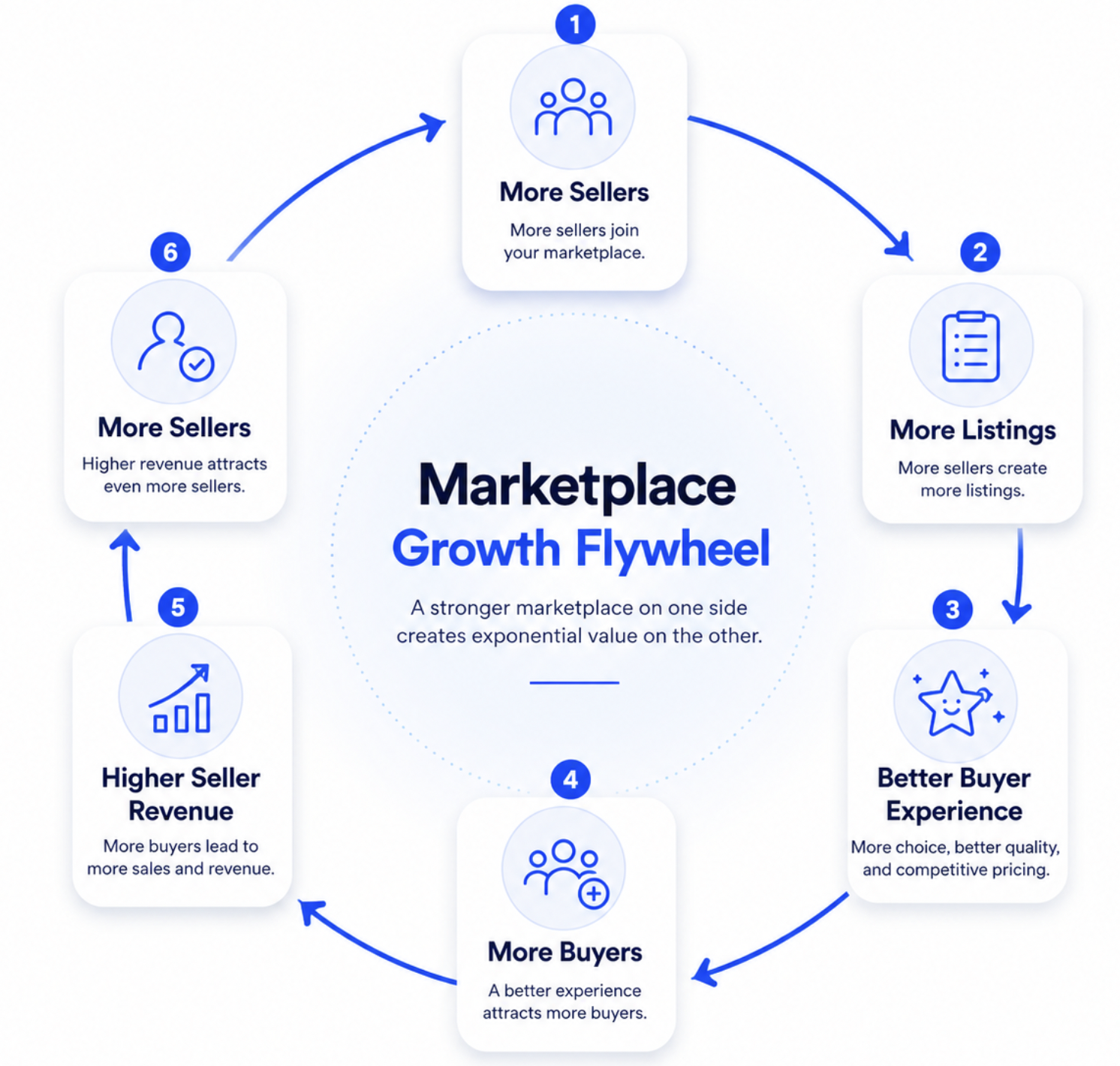
Every improvement to one side of the marketplace benefits the other.
This is known as a network effect, and it's one of the biggest competitive advantages marketplace businesses possess.
The Biggest Difference Between Successful and Unsuccessful Founders
After working with hundreds of marketplace founders, one pattern stands out above everything else.
Successful founders treat software as an accelerator.
Unsuccessful founders treat software as the product.
Successful founders spend their time:
- Talking to customers.
- Recruiting sellers.
- Acquiring buyers.
- Improving onboarding.
- Measuring KPIs.
- Building partnerships.
Unsuccessful founders spend months debating:
- Fonts
- Colors
- Dashboards
- Minor feature requests
- Perfect UI details
Customers rarely care whether your dashboard has rounded corners.
They care whether your marketplace solves their problem.
Our Biggest Lesson From 500+ Marketplace Launches
If we could give every first-time founder one piece of advice, it would be this:
Launch before you feel ready.
No software roadmap survives first contact with real customers.
The founders who succeed aren't the ones who launch perfect marketplaces.
They're the ones who learn the fastest.
That's why choosing marketplace software is ultimately about choosing how quickly you can start learning.
Frequently Asked Questions About Marketplace Software
Final Recommendation
Choosing marketplace software is one of the first major decisions you'll make as a founder—but it shouldn't become the biggest obstacle to launching your business.
After helping launch 500+ online marketplaces, we've consistently found that the founders who succeed aren't the ones with the most features or the most custom code.
They're the founders who launch quickly, learn continuously, and spend the majority of their time talking to customers rather than managing software projects.
The right marketplace platform should accelerate your business—not become your business.
Our Recommendation
If you're launching a new marketplace, optimize for three things:
1. Launch Speed
Your first goal isn't building the perfect marketplace.
It's validating that customers are willing to use—and pay for—your marketplace.
The sooner you launch, the sooner you'll begin collecting the feedback that shapes your product roadmap.
2. Marketplace-Specific Functionality
Avoid rebuilding infrastructure that already exists.
Core marketplace features such as:
- User authentication
- Payment splitting
- Messaging
- Reviews
- Scheduling
- User permissions
- Notifications
- Search
should already be solved so you can focus on what makes your marketplace unique.
3. Long-Term Flexibility
Your marketplace will evolve.
The software you choose today should still support your business several years from now without requiring an expensive rebuild.
Look for platforms that balance:
- Fast launch
- Marketplace functionality
- API extensibility
- Design flexibility
- Scalability
instead of forcing you to compromise on one or the other.
When Tangram Is a Great Fit
Tangram is designed for founders who want to:
- Launch in weeks—not months.
- Build a professional marketplace without hiring an expensive development agency.
- Use AI to dramatically accelerate development while still benefiting from expert human review.
- Avoid rebuilding marketplace infrastructure like payments, scheduling, messaging, authentication, and reviews.
- Continue customizing and scaling their marketplace as their business grows.
Whether you're building a:
- Service marketplace
- Rental marketplace
- Multi-vendor marketplace
- Talent marketplace
- B2B marketplace
- C2C marketplace
- Local marketplace
Tangram was built specifically for marketplace businesses—not generic websites.
When Another Platform May Be a Better Fit
Tangram isn't necessarily the best choice for everyone.
Another platform may be a better fit if:
- You're only building a simple directory with no marketplace transactions.
- Your company already has an experienced engineering team committed to building and maintaining everything from scratch.
- Your marketplace requires highly specialized workflows that cannot reasonably be implemented using existing marketplace infrastructure.
Choosing the right platform is ultimately about choosing the one that best aligns with your business—not simply the one with the longest feature list.
The Biggest Lesson We've Learned
If we could give every first-time marketplace founder one piece of advice, it would be this:
Don't spend six months building software before you've spent six weeks talking to customers.
Your marketplace will change.
Your roadmap will change.
Your assumptions will change.
The only way to discover what truly matters is by launching, learning, and continuously improving.
Marketplace software should help you reach that point faster.
Start Building Your Marketplace
Every successful marketplace started with a single transaction.
The sooner you launch, the sooner you'll begin learning what your customers actually need—and that's the foundation of every great marketplace business.
If you're evaluating marketplace software and want a platform that combines marketplace-specific functionality, AI-assisted development, and expert human guidance, we'd love to help.
Ready to launch your marketplace?
Explore Tangram, schedule a demo, or start building your marketplace today.
About the Author
Paris Mielke is the Founder of Tangram, an AI-enabled marketplace software platform that has helped launch more than 500 online marketplaces across industries including beauty & wellness, education, legal services, professional services, rentals, local services, and more.
Working directly with marketplace founders has provided firsthand insight into the technical and business challenges involved in launching, validating, and scaling multi-sided marketplaces. The lessons throughout this guide are based on real implementation experience—not just software feature comparisons.
Get notified of new features & resources.
Subscribe to our newsletter and stay up-to-date on our roadmap, new features, and free resources to help you scale your marketplace.
%2020.39.51%201%20(1).png)
%2020.39.51%202%20(2).png)
%2020.39.51%204%20(2).png)
%2020.39.51%203%20(1).png)
.png)