


What Is a White-Label Marketplace Solution?

Quick Answer
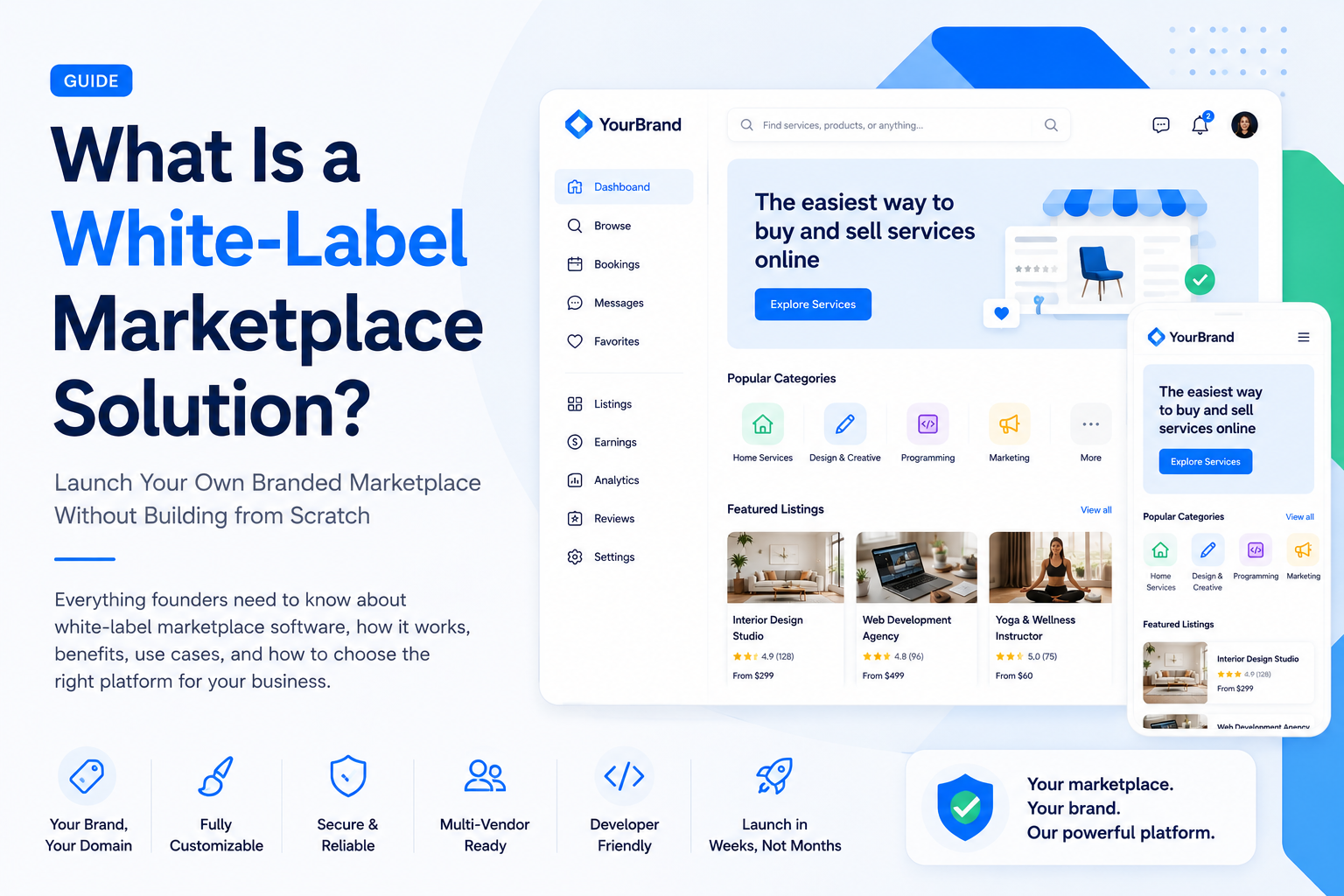
A white-label marketplace solution is marketplace software that allows businesses to launch a fully branded online marketplace without building the core technology from scratch. Instead of developing payments, messaging, reviews, user authentication, scheduling, and marketplace infrastructure yourself, you customize an existing marketplace platform with your own branding, domain, design, and business logic.
TL;DR
- White-label marketplace software lets you launch under your own brand.
- Customers never see the software provider's branding.
- It dramatically reduces development time and cost.
- Most startups are better served by white-label marketplace software than custom development.
- The best white-label platforms still allow extensive customization and future scalability.
What Is a White-Label Marketplace Solution?
A white-label marketplace solution is pre-built marketplace software that can be customized to look and behave as if it were developed specifically for your company.
Your customers interact only with your brand.
They don't know which marketplace platform powers the application behind the scenes.
For example:
A founder launching a marketplace for fitness instructors might use a white-label marketplace platform while branding everything with:
- Their own logo
- Custom colors
- Their own domain
- Personalized user experience
- Unique pricing model
- Marketplace policies
To customers, it appears to be entirely custom software.
What Does "White Label" Mean?
"White label" refers to software or products created by one company but rebranded and sold by another.
Examples include:
- Payment platforms
- CRM software
- Website builders
- Marketplace software
- Banking software
Marketplace software follows the same model.
Instead of reinventing complex infrastructure, founders customize an existing platform while focusing on growing their business.
White-Label Marketplace Software vs Custom Marketplace Development
This is one of the biggest decisions founders face.
Neither option is universally better.
The right choice depends on your business.
Our Experience Helping Launch 500+ Marketplaces
One pattern has emerged across nearly every founder we've worked with.
Most initially assume they need custom software.
After discussing their marketplace idea, we often discover they require many of the same foundational features as every other marketplace:
- Listings
- Messaging
- Reviews
- Scheduling
- Payments
- User permissions
- Notifications
- Search
- Marketplace administration
Very few founders gain a competitive advantage by rebuilding those systems.
Instead, they create differentiation through:
- Better branding
- Better customer acquisition
- Better niche selection
- Better user experience
- Better operations
That's why white-label marketplace software has become such a compelling option.
What Features Should White-Label Marketplace Software Include?
Not every platform offers the same capabilities.
At minimum, look for:
Marketplace Infrastructure
- Listings
- Reviews
- Messaging
- User authentication
- Search
- Notifications
Payments
Look for:
- Stripe Connect
- Marketplace commissions
- Vendor payouts
- Subscription billing
- Refund support
User Roles
Marketplace software should support:
- Buyers
- Sellers
- Administrators
- Moderators (if needed)
Design Customization
Your marketplace should feel like your company—not a template.
Look for platforms that allow:
- Custom branding
- Design flexibility
- Landing pages
- Marketing pages
- Responsive layouts
API Support
Even if you don't need integrations today, APIs make future growth much easier.
Common integrations include:
- CRMs
- Email marketing
- Analytics
- Accounting
- Mobile apps
- ERP systems
Types of White-Label Marketplaces
White-label marketplace software supports many industries.
Service Marketplace Software
Examples:
- Home services
- Legal services
- Beauty & wellness
- Tutoring
- Consulting
Rental Marketplace Software
Examples:
- Vacation rentals
- Equipment rentals
- Event rentals
- Vehicle rentals
Talent Marketplace Software
Examples:
- Freelancers
- Agencies
- Consultants
- Contractors
B2B Marketplace Software
Examples:
- Manufacturers
- Suppliers
- Wholesalers
C2C Marketplace Software
Examples:
- Local resale
- Collectibles
- Peer-to-peer marketplaces
White Label Doesn't Mean Limited
This is one of the biggest misconceptions.
Many founders assume white-label software means they can't customize their marketplace.
Modern marketplace platforms often allow:
- Custom branding
- Custom layouts
- APIs
- Custom workflows
- AI-generated pages
- Integrations
- Developer extensions
Good white-label software accelerates development without preventing innovation.
White Label vs No-Code Marketplace Builders
These categories overlap but aren't identical.
No-code builders help create applications visually.
White-label marketplace platforms already understand marketplace businesses.
Marketplace software includes specialized workflows like:
- Vendor onboarding
- Marketplace commissions
- Multi-vendor permissions
- Payment splitting
- Reviews
- Messaging
Those systems often require extensive custom work when using generic no-code platforms.
White Label vs AI Marketplace Builders
AI is changing software development rapidly.
Modern AI marketplace builders can generate pages and interfaces significantly faster than traditional development.
However, AI-generated applications still benefit from marketplace-specific infrastructure and human review.
In our experience, AI performs best when accelerating marketplace development rather than replacing marketplace expertise.
When Should You Choose a White-Label Marketplace Solution?
White-label marketplace software is usually the right choice if:
- You want to launch quickly.
- You're validating a new business.
- You want lower upfront costs.
- You don't want to rebuild marketplace infrastructure.
- You still want flexibility as your marketplace grows.
When Custom Development Makes More Sense
Custom development may be appropriate if:
- Your workflow is highly specialized.
- Existing marketplace platforms genuinely cannot support your requirements.
- Technology itself is your competitive advantage.
- You already have an experienced engineering team.
The Biggest Mistake Founders Make
The most expensive mistake isn't choosing the wrong software.
It's assuming custom software automatically creates a better marketplace.
Successful marketplaces succeed because they solve customer problems—not because they rebuilt authentication, messaging, or payment systems.
Launch speed almost always creates more value than rebuilding existing infrastructure.
Frequently Asked Questions
Final Thoughts
White-label marketplace software has fundamentally changed how marketplaces are built.
Instead of spending months rebuilding technology that already exists, founders can focus on acquiring customers, validating their marketplace, and creating sustainable network effects.
After helping launch more than 500 online marketplaces, we've found that the founders who grow the fastest aren't the ones who build the most software—they're the ones who reach real customers the fastest.
A modern white-label marketplace solution allows you to do exactly that: launch under your own brand, leverage proven marketplace infrastructure, and spend your time building a successful business instead of rebuilding technology.
If you're evaluating platforms, we recommend also reading our comprehensive guide:
How to Choose the Best Marketplace Software (2026 Buyer's Guide)
It compares today's leading marketplace platforms, explores hidden costs, and provides a practical framework for choosing the right software for your marketplace.
Get notified of new features & resources.
Subscribe to our newsletter and stay up-to-date on our roadmap, new features, and free resources to help you scale your marketplace.
%2020.39.51%201%20(1).png)
%2020.39.51%202%20(2).png)
%2020.39.51%204%20(2).png)
%2020.39.51%203%20(1).png)
.png)