


What is a three sided marketplace?

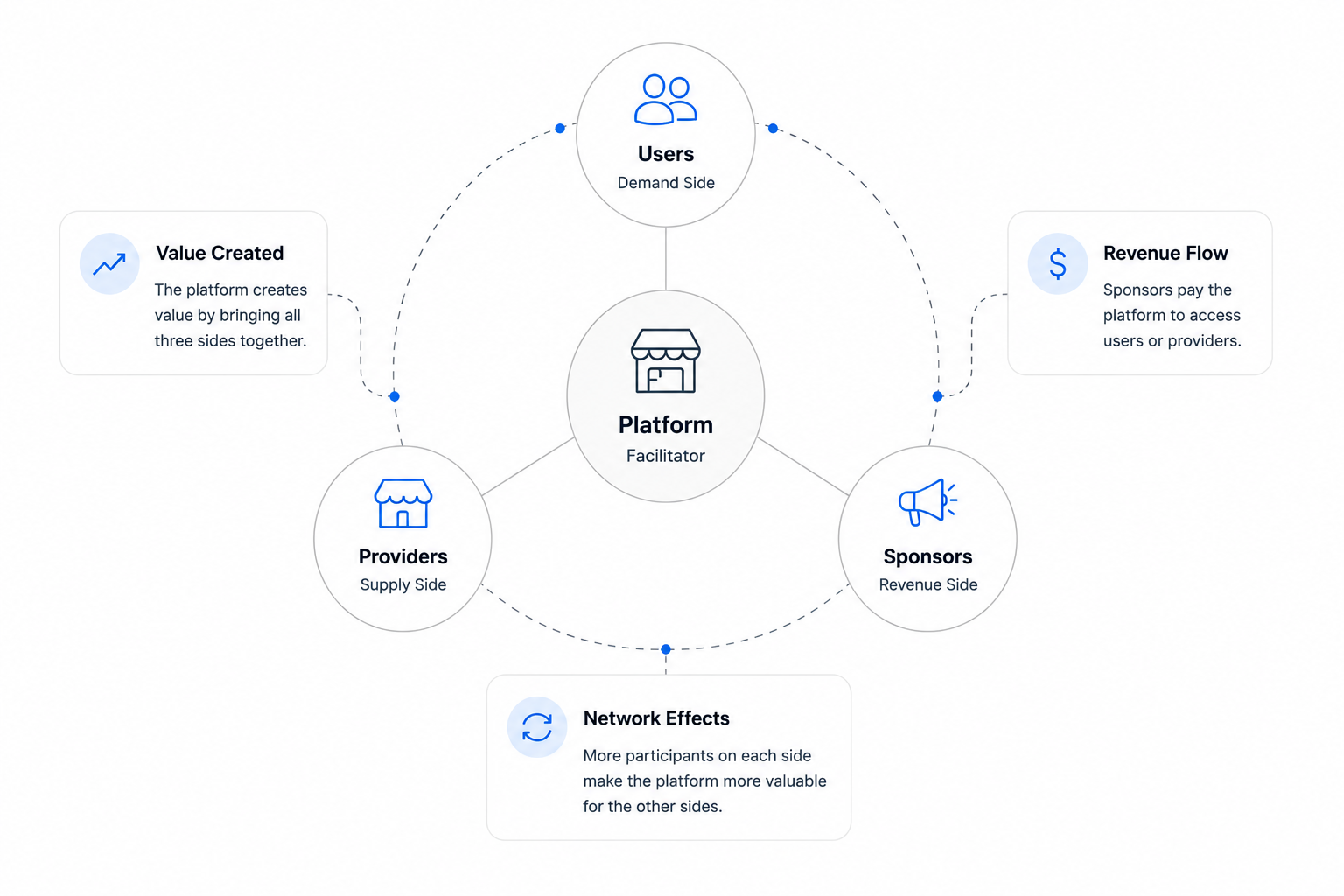
A three-sided marketplace is a marketplace business model that connects three distinct groups of users who each create value for one another through a single platform. While a traditional two sided marketplace connects buyers and sellers, a three-sided marketplace introduces a third participant—such as advertisers, sponsors, recruiters, insurers, payment providers, or other strategic partners—that helps monetize, grow, or improve the platform.
Examples include marketplaces that connect customers with service providers while allowing businesses to sponsor listings, job marketplaces that connect employers and candidates while recruiters facilitate hiring, or education platforms where instructors, students, and organizations all participate.
As AI continues to make marketplace software development faster than ever, understanding marketplace strategy—not just technology—is becoming the real competitive advantage.
AI builds software. Human expertise builds successful businesses. The best marketplace builders combine both.
Quick Answer
A three-sided marketplace expands upon a traditional two sided marketplace business model by adding a third participant that creates additional value for the ecosystem. Instead of simply matching buyers and sellers, the platform coordinates interactions between three independent groups that all benefit from one another.
Examples include:
- Customers
- Service providers
- Advertisers
or
- Students
- Tutors
- Schools
or
- Employers
- Candidates
- Recruiters
What Is a Three-Sided Marketplace?
A traditional marketplace has two groups:
- Buyers
- Sellers
A three sided marketplace introduces another participant.
That third participant might:
- Generate additional revenue
- Improve trust
- Increase distribution
- Supply additional inventory
- Create network effects
- Subsidize one side of the marketplace
The platform sits in the middle, creating value for all three groups.
Unlike standard ecommerce websites, marketplace businesses coordinate relationships—not just transactions.
Two-Sided vs. Three-Sided Marketplaces
What Is a Three-Sided Marketplace?
A three-sided marketplace is a marketplace business model that connects three distinct groups of users who each create value for one another through a single platform. While a traditional two sided marketplace connects buyers and sellers, a three-sided marketplace introduces a third participant—such as advertisers, sponsors, recruiters, insurers, payment providers, or other strategic partners—that helps monetize, grow, or improve the platform.
Examples include marketplaces that connect customers with service providers while allowing businesses to sponsor listings, job marketplaces that connect employers and candidates while recruiters facilitate hiring, or education platforms where instructors, students, and organizations all participate.
As AI continues to make marketplace software development faster than ever, understanding marketplace strategy—not just technology—is becoming the real competitive advantage.
AI builds software. Human expertise builds successful businesses. The best marketplace builders combine both.
Quick Answer
A three-sided marketplace expands upon a traditional two sided marketplace business model by adding a third participant that creates additional value for the ecosystem. Instead of simply matching buyers and sellers, the platform coordinates interactions between three independent groups that all benefit from one another.
Examples include:
- Customers
- Service providers
- Advertisers
or
- Students
- Tutors
- Schools
or
- Employers
- Candidates
- Recruiters
What Is a Three-Sided Marketplace?
A traditional marketplace has two groups:
- Buyers
- Sellers
A three sided marketplace introduces another participant.
That third participant might:
- Generate additional revenue
- Improve trust
- Increase distribution
- Supply additional inventory
- Create network effects
- Subsidize one side of the marketplace
The platform sits in the middle, creating value for all three groups.
Unlike standard ecommerce websites, marketplace businesses coordinate relationships—not just transactions.
Two-Sided vs. Three-Sided Marketplaces
Two-Sided MarketplaceThree-Sided MarketplaceBuyers and sellersThree distinct user groupsOne primary interactionMultiple interconnected interactionsSimpler monetizationMultiple revenue streamsEasier to launchMore complex marketplace dynamicsLower coordination complexityGreater network effects
Examples of Three-Sided Marketplaces
1. Uber
- Riders
- Drivers
- Restaurants (Uber Eats) or Advertisers
2. Airbnb
- Guests
- Hosts
- Professional property managers / service providers
3. LinkedIn
- Professionals
- Employers
- Recruiters
4. Indeed
- Job seekers
- Employers
- Recruiters
5. Eventbrite
- Event organizers
- Attendees
- Sponsors
Why Build a Three-Sided Marketplace?
Adding a third side can dramatically increase the value of your platform.
Benefits include:
- More revenue opportunities
- Stronger network effects
- Increased customer retention
- Better marketplace liquidity
- Additional acquisition channels
- More defensible business model
However, it also introduces additional complexity.
Challenges of Three-Sided Marketplaces
Three-sided marketplaces are more difficult to operate because you aren't balancing two groups—you are balancing three.
Common challenges include:
Attracting Three User Groups
The classic chicken-and-egg problem becomes even harder.
Instead of attracting buyers and sellers, you're also trying to convince a third participant that the platform is valuable.
Balancing Supply and Demand
Every new participant changes marketplace dynamics.
Too many providers...
Customers leave.
Too many customers...
Providers become overwhelmed.
Too many advertisers...
The user experience suffers.
Marketplace Liquidity
Marketplace liquidity becomes even more important.
Each side must receive enough value to continue participating.
If one group leaves, the other two often become less valuable as well.
Building Trust
Trust isn't just between buyers and sellers anymore.
The platform must create confidence among all three groups.
That usually requires:
- User verification
- Reviews
- Secure payments
- Transparent policies
- Moderation
- Reliable communication
Choosing the Right Marketplace Software
Most website builders aren't designed for three sided marketplace businesses.
A proper marketplace software platform needs to support:
- Multiple user roles
- Different permissions
- Independent dashboards
- Marketplace messaging
- Payment splitting
- Scheduling
- Reviews
- Notifications
- Analytics
- Admin moderation
Whether you're building service marketplace software, rental marketplace software, B2B marketplace software, or C2C marketplace software, marketplace infrastructure becomes increasingly valuable as complexity grows.
Common Monetization Models
Three-sided marketplaces often combine multiple revenue streams.
Examples include:
- Transaction commissions
- Monthly subscriptions
- Featured listings
- Sponsored placements
- Advertising
- Lead generation
- Enterprise plans
- API access
Unlike many two sided marketplace examples, adding a third participant allows platforms to monetize without charging every user.
When Should You Build a Three-Sided Marketplace?
Most founders should not start with three sides.
Instead:
Launch as a two-sided marketplace.
Validate demand.
Achieve marketplace liquidity.
Then introduce the third participant once you've proven value.
Trying to solve three acquisition problems simultaneously usually slows down growth.
AI Is Changing Marketplace Development
Building marketplace software has never been easier.
AI can generate interfaces, workflows, and application logic much faster than traditional development.
What AI cannot reliably determine is:
- Which side should subsidize the others.
- When to introduce a third participant.
- Which monetization model fits your business.
- How to balance marketplace incentives.
That's where marketplace expertise still matters.
Technology is no longer the bottleneck.
Business decisions are.
How Tangram Helps
Tangram was built because we repeatedly saw founders spending months rebuilding the same marketplace functionality.
Instead of recreating authentication, messaging, reviews, payments, scheduling, and user management from scratch, founders can leverage marketplace-specific infrastructure while focusing their development efforts on what actually differentiates their business.
Whether you're building a multi vendor marketplace software platform, talent marketplace software, white label marketplace software, or exploring an AI marketplace builder, the goal should be the same:
Spend your development budget on your unique business—not on rebuilding commodity marketplace features.
Frequently Asked Questions
Get notified of new features & resources.
Subscribe to our newsletter and stay up-to-date on our roadmap, new features, and free resources to help you scale your marketplace.
%2020.39.51%201%20(1).png)
%2020.39.51%202%20(2).png)
%2020.39.51%204%20(2).png)
%2020.39.51%203%20(1).png)
.png)