


What Is a Niche Marketplace?

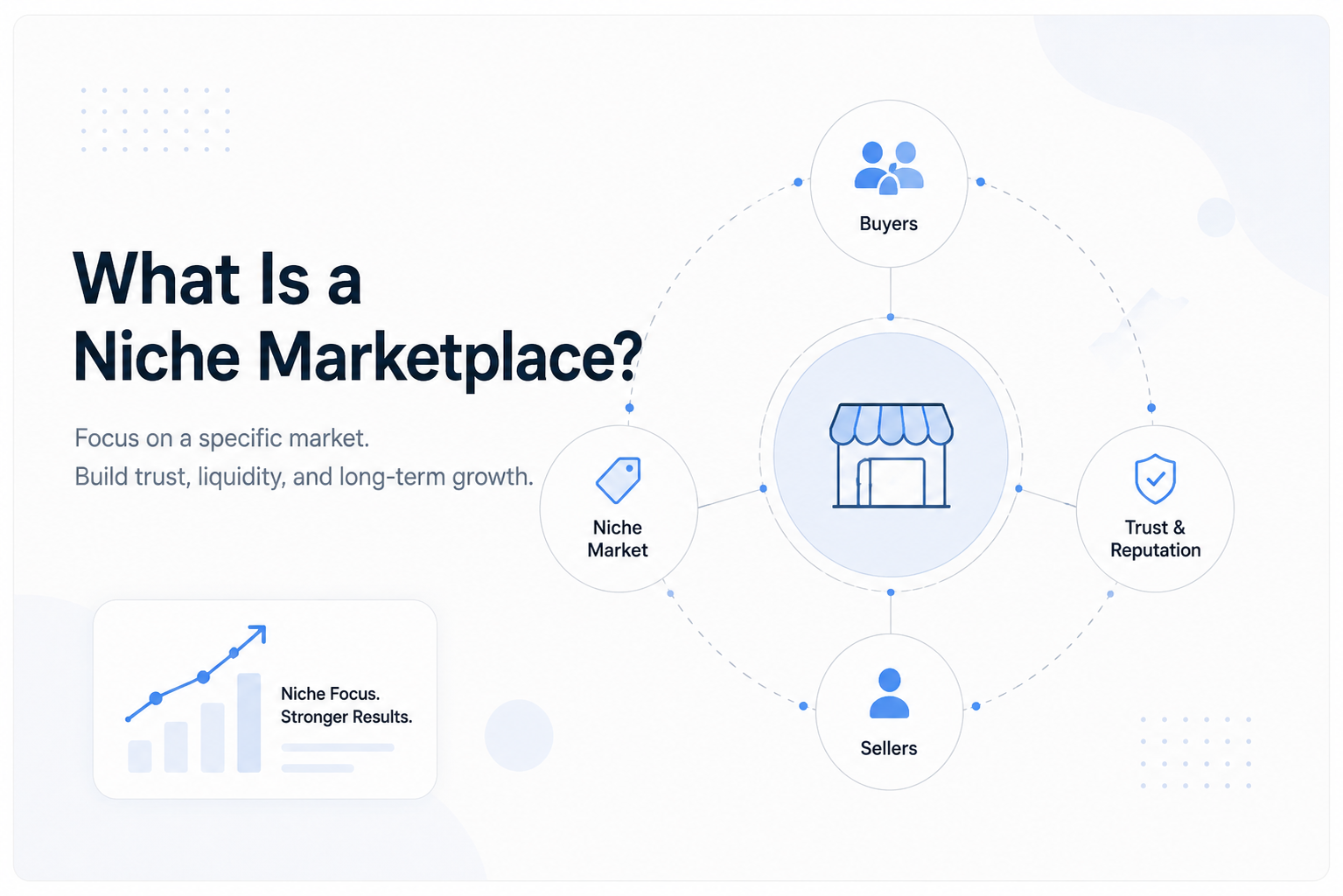
A niche marketplace is an online marketplace that focuses on serving a specific industry, customer segment, geographic region, or type of product or service instead of trying to compete with broad platforms like Amazon or eBay. By specializing in one audience, niche marketplaces can build stronger trust, create better user experiences, and achieve marketplace liquidity much faster.
Whether you're building service marketplace software, rental marketplace software, B2B marketplace software, or another type of multi vendor marketplace software, starting with a niche is often the fastest path to validating demand and growing into a larger platform.
Quick Answer
A niche marketplace is an online platform that connects buyers and sellers within a specific market rather than serving everyone. Instead of becoming "the next Amazon," successful marketplace founders usually solve one very specific problem exceptionally well before expanding into adjacent markets.
What Is a Niche Marketplace?
A niche marketplace focuses on a well-defined audience.
That niche might be based on:
- Industry
- Geography
- Product category
- Service category
- Customer demographic
- Hobby or interest
- Business size
Unlike general marketplaces that list millions of products, niche marketplaces intentionally narrow their focus to create a better experience for a specific community.
Why Are Niche Marketplaces So Successful?
Many founders assume bigger is better.
In reality, most successful marketplaces begin small.
The biggest challenge for any two sided marketplace isn't building software—it's creating enough activity that buyers and sellers consistently find value.
Starting with a niche helps solve that problem by concentrating supply and demand into a smaller community.
Instead of competing with everyone, you're becoming the best solution for someone.
Examples of Niche Marketplaces
Notice that none of these marketplaces tried to serve every customer from day one.
Types of Niche Marketplaces
Industry-Based
Examples:
- Healthcare
- Construction
- Legal
- Manufacturing
- Education
These marketplaces often require industry-specific workflows and compliance features.
Service Marketplaces
Service marketplaces connect customers with professionals.
Examples include:
- Tutors
- Coaches
- Personal trainers
- Therapists
- Contractors
These often require scheduling, messaging, reviews, and user verification.
Geographic Marketplaces
Some marketplaces only operate within:
- Cities
- States
- Countries
- Campuses
- Neighborhoods
Concentrating users geographically makes it much easier to achieve marketplace liquidity.
B2B Marketplaces
B2B marketplace software connects businesses instead of consumers.
Examples include:
- Wholesale suppliers
- Manufacturing
- Equipment rentals
- Logistics
- Professional services
These often require custom pricing, invoices, RFQs, and account permissions.
Community Marketplaces
Some marketplaces serve communities based on shared interests.
Examples:
- Artists
- Collectors
- Gamers
- Universities
- Professional associations
Trust and community often become the competitive advantage.
Why Founders Should Start Small
One of the biggest mistakes marketplace founders make is trying to build for everyone.
Broad marketplaces require enormous marketing budgets because supply and demand are spread too thin.
Instead, define a very specific customer.
Ask yourself:
- Who is my first ideal customer?
- What problem do they have today?
- Where do they currently solve it?
- Why would they switch?
Once you've dominated one niche, expanding becomes dramatically easier.
Common Features of Niche Marketplaces
The exact features depend on your industry, but most marketplaces include:
- User accounts
- User verification
- Listings
- Search and filtering
- Reviews
- Messaging
- Notifications
- Online payments
- Scheduling (service marketplaces)
- Admin moderation
- Analytics
These are the foundational building blocks of modern marketplace software platforms.
How AI Is Changing Niche Marketplace Development
Building marketplace software has become dramatically faster.
Instead of spending six months rebuilding authentication, payments, reviews, messaging, scheduling, and user management, founders can now leverage AI alongside marketplace infrastructure.
This allows founders to spend more time validating customers instead of rebuilding common functionality.
Technology is becoming cheaper.
Customer acquisition isn't.
Should You Build Custom Software?
Five years ago, building custom marketplace software was often the only option.
Today, many founders can launch much faster using marketplace-specific infrastructure.
Rather than spending tens or hundreds of thousands of dollars rebuilding common marketplace functionality, invest that budget into customer acquisition, branding, and unique features.
Custom development should differentiate your marketplace—not recreate payments, messaging, authentication, or booking systems.
Common Mistakes
Many marketplace founders delay success because they:
- Try to serve everyone.
- Build too many features before launching.
- Choose software before defining MVP requirements.
- Ignore marketplace liquidity.
- Spend their budget rebuilding commodity functionality.
- Wait for the "perfect" product instead of validating with real customers.
Launch sooner.
Learn faster.
Expand later.
How Tangram Helps
Tangram was built specifically for founders building marketplaces—not generic websites.
Unlike traditional website builders, marketplace platforms require business logic like:
- User accounts
- Multi-vendor listings
- Reviews
- Messaging
- Payments
- Scheduling
- User permissions
- Marketplace monetization
Instead of rebuilding those systems from scratch, founders can launch faster while keeping the flexibility to extend their platform over time.
Whether you're creating a service marketplace software, rental marketplace software, talent marketplace software, or another AI marketplace builder project, starting with marketplace-specific infrastructure dramatically reduces development time.
Frequently Asked Questions
Final Thoughts
The biggest advantage of a niche marketplace isn't simply less competition—it's focus.
By solving one problem exceptionally well for one audience, founders can achieve marketplace liquidity, build trust, and validate demand much faster than broad marketplaces trying to compete with everyone.
The best marketplaces rarely start as the biggest.
They start as the most useful.
AI builds software. Human expertise builds successful businesses. The best marketplace builders combine both.
Get notified of new features & resources.
Subscribe to our newsletter and stay up-to-date on our roadmap, new features, and free resources to help you scale your marketplace.
%2020.39.51%201%20(1).png)
%2020.39.51%202%20(2).png)
%2020.39.51%204%20(2).png)
%2020.39.51%203%20(1).png)
.png)