


What Are the Biggest Challenges of Running a Marketplace?

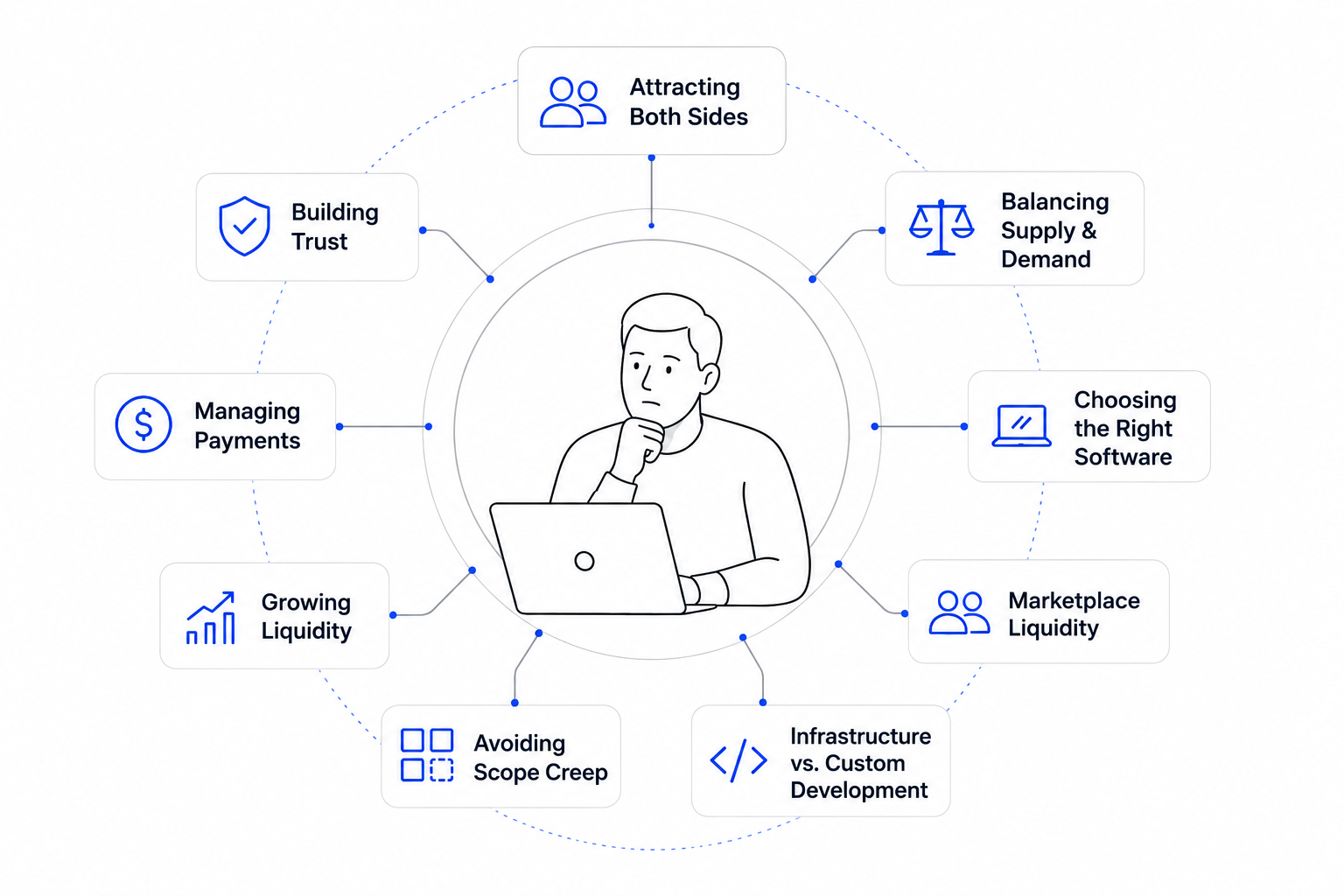
Running an online marketplace can be one of the most rewarding business models, but it's also one of the most difficult. Unlike traditional ecommerce websites, marketplaces must attract two groups of users, build trust between strangers, facilitate transactions, and continuously balance supply with demand.
Whether you're launching a service marketplace software platform, rental marketplace software, B2B marketplace software, or another multi vendor marketplace software business, understanding these challenges before you launch can save months of frustration and thousands of dollars in unnecessary development.
The Biggest Challenges of Running a Marketplace
Every marketplace is different, but nearly every successful platform eventually faces the same core challenges.
1. Solving the Chicken-and-Egg Problem
The biggest challenge for nearly every two sided marketplace is convincing buyers to join without sellers—and convincing sellers to join without buyers.
Unlike a traditional ecommerce website, marketplaces create value only when both sides of the platform are active.
This is why many founders spend too much time building software before validating demand.
Instead of launching with every feature imaginable, focus on solving a specific problem for a narrow audience first.
2. Defining the Right MVP
One of the biggest mistakes founders make is choosing software before defining what they actually need to build.
Many marketplace founders compare platforms based on marketing pages instead of creating a detailed product specification.
Your MVP should answer one question:
Can strangers successfully complete a transaction on my platform?
Everything else can usually wait.
3. Building Trust
People don't transact with strangers unless they feel safe.
That's why successful marketplaces invest heavily in:
- User authentication
- Verification
- Reviews
- Secure payments
- Messaging
- Transparent policies
Whether you're building peer to peer marketplace builder software or a talent marketplace software platform, trust is your product—not just your technology.
4. Marketplace Liquidity
Many founders believe launching software automatically creates a marketplace.
It doesn't.
The goal isn't launching.
The goal is creating enough activity that buyers consistently find sellers and sellers consistently receive opportunities.
This is often called marketplace liquidity.
Without it, even beautiful software fails.
5. Managing Supply and Demand
A healthy marketplace requires balance.
Too many sellers...
Providers leave.
Too many buyers...
Customers can't find availability.
Understanding two sided marketplace network effects and how supply and demand interact is one of the most important skills a marketplace founder can develop.
6. Choosing the Right Marketplace Software
Marketplace founders often underestimate how much business logic exists beneath the surface.
Unlike a normal website, marketplaces require:
- User accounts
- Listings
- Reviews
- Search
- Filters
- Messaging
- Scheduling
- Split payments
- Notifications
- Admin moderation
- Permissions
This is why generic website builders often struggle as marketplaces become more complex.
A dedicated marketplace software platform already understands these relationships.
7. Avoiding Scope Creep
One lesson we've learned building Tangram is that founders rarely fail because they didn't build enough features.
They fail because they never launch.
Every additional feature delays customer feedback.
The best marketplace founders build the smallest professional product possible.
8. Deciding Between Custom Development and Marketplace Infrastructure
Five years ago, custom development was often the only option.
Today, AI has changed that equation.
Instead of spending six months rebuilding authentication, payments, messaging, reviews, scheduling, and vendor management, founders can use marketplace infrastructure and invest their development budget where it actually creates competitive advantage.
Custom development should build your unique business—not commodity marketplace features.
What Makes Marketplaces So Much Harder Than Websites?
Traditional websites primarily display content.
Marketplace businesses coordinate relationships.
A successful marketplace software platform has to manage:
- Multiple user types
- Listings
- Payments
- Messaging
- Search
- Availability
- Reviews
- Permissions
- Notifications
- Marketplace economics
This complexity is why marketplace-specific software exists.
Common Mistakes Marketplace Founders Make
- Building before validating demand.
- Choosing software before defining requirements.
- Trying to launch with every feature.
- Ignoring marketplace liquidity.
- Assuming AI alone can design the right product.
- Hiring developers to rebuild common marketplace infrastructure.
- Focusing on software instead of customer acquisition.
How AI Is Changing Marketplace Development
AI has dramatically lowered the cost of building software.
It has not eliminated the need for marketplace expertise.
AI can generate interfaces, workflows, and code.
It cannot reliably decide:
- What should be included in an MVP.
- Which monetization model fits your marketplace.
- How to balance buyers and sellers.
- How to build trust.
- When to prioritize supply over demand.
The future isn't AI or humans.
It's AI accelerated by marketplace experts who understand marketplace businesses.
How Tangram Approaches These Challenges
Tangram was created because we repeatedly saw founders spend months rebuilding the same marketplace functionality.
Instead of investing heavily in authentication, payments, messaging, scheduling, reviews, and vendor management, we believe founders should focus their resources on the unique parts of their marketplace.
AI helps accelerate implementation.
Marketplace expertise helps ensure you're building the right product.
Frequently Asked Questions
Final Thoughts
Running a marketplace is challenging because you're not just building software—you're building an ecosystem.
Technology has become dramatically easier thanks to AI, but marketplace success still depends on solving trust, liquidity, monetization, and user experience.
The founders who succeed aren't necessarily the ones with the biggest budgets or the most features. They're the ones who launch quickly, learn from real users, and continuously improve their marketplace over time.
AI builds software. Human expertise builds successful businesses. The best marketplace builders combine both.
Get notified of new features & resources.
Subscribe to our newsletter and stay up-to-date on our roadmap, new features, and free resources to help you scale your marketplace.
%2020.39.51%201%20(1).png)
%2020.39.51%202%20(2).png)
%2020.39.51%204%20(2).png)
%2020.39.51%203%20(1).png)
.png)