


How Do Marketplace Commissions Work?

Quick Answer
Marketplace commissions are the fees a marketplace charges for facilitating transactions between buyers and sellers. Most marketplaces charge a percentage of each transaction, although many also use subscriptions, flat fees, lead fees, or hybrid pricing models. The right commission structure depends on your marketplace's business model, industry, and stage of growth.
TL;DR
- Marketplace commissions are how most two-sided marketplaces generate revenue.
- Commissions can be charged to buyers, sellers, or both.
- Percentage-based commissions are the most common model.
- Many successful marketplaces combine subscriptions with lower commissions.
- Early-stage marketplaces should prioritize liquidity before maximizing commission revenue.
- Stripe Connect makes payment splitting significantly easier for modern marketplace software.
- After helping launch 500+ marketplaces, we've found founders often overcomplicate pricing when simple models perform better.
What Are Marketplace Commissions?
Marketplace commissions are fees charged by a marketplace whenever a successful transaction occurs.
Instead of selling products or services themselves, marketplaces facilitate transactions between independent buyers and sellers.
The marketplace earns revenue by taking a small portion of each transaction.
Examples include:
- Airbnb charging hosts and guests
- Etsy charging sellers
- Fiverr taking a percentage of freelancer earnings
- Uber charging drivers a service fee
- Upwork charging freelancer commissions
Without commissions, many marketplaces would have no sustainable business model.
How Do Marketplace Commissions Work?
The process is surprisingly simple.
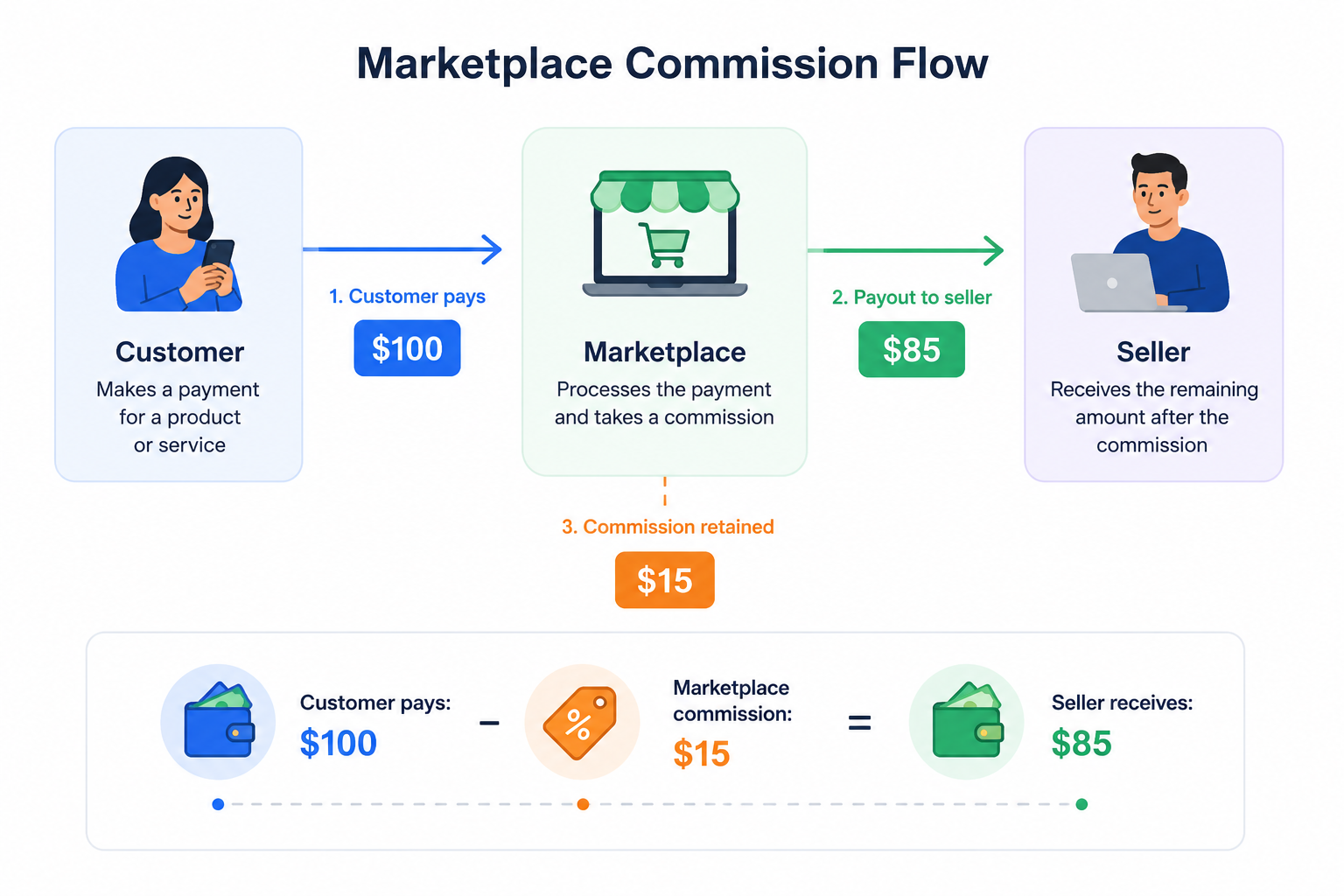
- A buyer purchases a product or service.
- Payment is processed.
- The marketplace deducts its commission.
- The remaining funds are transferred to the seller.
- Both parties receive confirmation.
For example:
Modern marketplace software platforms automate this entire workflow using payment providers such as Stripe Connect.
Why Most Marketplaces Charge Commissions
Commissions naturally align the incentives of the marketplace with its users.
The marketplace only earns money when sellers earn money.
That creates a strong incentive to:
- Attract more buyers
- Increase transactions
- Improve seller success
- Build trust
- Reduce friction
Unlike fixed monthly fees, commission-based pricing scales alongside marketplace growth.
Common Marketplace Commission Models
Every marketplace is different.
Here are the most common pricing models we've seen after helping launch more than 500 online marketplaces.
Percentage Commission
The marketplace takes a percentage of every transaction.
Example:
.png)
Best for
- Service marketplace software
- Rental marketplace software
- Freelance marketplace builders
- Two-sided marketplaces
Pros
- Simple
- Scales automatically
- Low barrier for sellers
Cons
- Revenue depends on transaction volume.
Flat Transaction Fee
Instead of charging a percentage, the marketplace charges a fixed amount.
Example:
.png)
Best for
Higher-value transactions with consistent pricing.
Buyer Fees
Some marketplaces charge buyers instead of sellers.
Examples include:
- Booking fees
- Convenience fees
- Platform fees
This approach can make the marketplace appear "free" for sellers.
Seller Fees
The most common marketplace model.
Sellers pay commissions because the marketplace helps them acquire customers.
Examples include:
- Airbnb
- Etsy
- Fiverr
- Upwork
Subscription + Lower Commission
One pattern we've repeatedly seen succeed is combining subscriptions with lower transaction fees.
Instead of relying entirely on commissions, sellers pay:
- Monthly subscription
- Lower percentage commission
This creates more predictable recurring revenue while keeping transaction fees competitive.
For newer marketplaces with lower transaction volume, this hybrid approach can significantly improve profitability.
Lead Fees
Rather than charging after payment, the marketplace charges sellers for qualified leads.
Common in:
- Home services
- Legal marketplaces
- Healthcare
- Local services
Freemium
Basic marketplace usage remains free.
Advanced functionality requires upgrading.
Examples include:
- Premium listings
- Analytics
- Marketing tools
- Featured placement
Hybrid Models
Many successful marketplaces eventually combine multiple pricing strategies.
For example:
- Monthly subscription
- Transaction commissions
- Featured listings
- Advertising
- Lead fees
Hybrid pricing provides flexibility as the marketplace grows.
Our Experience Helping Launch 500+ Marketplaces
One lesson stands out above almost everything else.
Founders spend far too much time optimizing commissions before they've solved marketplace liquidity.
Many first-time founders ask:
Should we charge 10%?
Or:
Should we charge 15%?
In reality, the exact percentage matters far less than whether buyers and sellers are actually using the marketplace.
Your first objective should be generating transactions.
Pricing can evolve.
Marketplaces change commission structures surprisingly often during their first few years.
That's why choosing software that allows rapid iteration is more valuable than locking yourself into a rigid pricing model.
The Chicken-and-Egg Problem Comes First
Before maximizing revenue, marketplaces must solve liquidity.
Without buyers:
Sellers leave.
Without sellers:
Buyers leave.
Charging commissions before you've established marketplace value can make growth significantly harder.
We've found founders often achieve better long-term results by focusing first on:
- Supply acquisition
- Customer onboarding
- Marketplace trust
- Repeat transactions
Only after those foundations exist should commission optimization become a major priority.
How Much Should You Charge?
There isn't a universal answer.
Commission rates vary by:
- Industry
- Transaction size
- Customer acquisition costs
- Competition
- Marketplace value
Instead of asking:
What's the perfect percentage?
Ask:
Does this pricing encourage both buyers and sellers to continue using the marketplace?
Healthy marketplaces optimize long-term participation rather than maximizing short-term revenue.
Buyer vs Seller Commissions
Should buyers or sellers pay?
Both approaches work.
Buyer Pays
Pros
- Sellers love free platforms.
- Easier seller acquisition.
Cons
- Higher checkout friction.
Seller Pays
Pros
- Industry standard.
- Buyers experience transparent pricing.
Cons
- Sellers evaluate ROI more carefully.
Both Pay
Many marketplaces charge both sides.
Examples include:
- Buyer booking fee
- Seller commission
This balances revenue while distributing costs across both participants.
How Stripe Connect Makes Marketplace Payments Easy
Managing marketplace payments manually is extremely difficult.
Modern marketplaces typically rely on Stripe Connect to automate:
- Payment splitting
- Vendor payouts
- Refunds
- Tax reporting
- Apple Pay
- ACH
- Credit cards
Instead of building payment infrastructure from scratch, founders can leverage trusted payment systems that already handle much of the complexity.
This is one reason we recommend using marketplace software that integrates directly with Stripe Connect.
Common Marketplace Commission Mistakes
After working with hundreds of founders, we've seen the same mistakes repeatedly.
Making Pricing Too Complicated
Simple pricing builds trust.
Complex pricing creates confusion.
If sellers can't immediately understand your pricing, it probably needs simplifying.
Charging Commissions Too Early
Before liquidity exists, every transaction matters.
Charging aggressive commissions before you've demonstrated marketplace value can slow adoption.
Ignoring Alternative Revenue Models
Commissions aren't the only way marketplaces make money.
Subscriptions, featured listings, advertising, lead generation, and premium tools can all create sustainable revenue.
Locking Into One Pricing Model
Many marketplaces evolve their pricing multiple times.
Choose marketplace software that allows pricing changes without months of custom development.
Marketplace Commission Examples
Each marketplace uses slightly different pricing, but all align revenue with successful transactions.
Marketplace Commissions vs Subscriptions
Many founders ask:
Should I charge commissions or subscriptions?
The answer depends on your marketplace.
Many marketplaces eventually combine both.
Tangram's Insights on Marketplace Monetization
After helping launch more than 500 marketplaces, these are the biggest lessons we've learned.
Launch before perfecting pricing.
Customers matter more than commission percentages.
Pricing will change.
Nearly every successful marketplace evolves its monetization over time.
Marketplace liquidity comes first.
No commission model works without buyers and sellers.
Simplicity wins.
Simple pricing consistently outperforms complicated fee structures.
Technology shouldn't slow pricing changes.
Founders should be able to iterate on monetization quickly—not wait months for developers.
Frequently Asked Questions
Get notified of new features & resources.
Subscribe to our newsletter and stay up-to-date on our roadmap, new features, and free resources to help you scale your marketplace.
%2020.39.51%201%20(1).png)
%2020.39.51%202%20(2).png)
%2020.39.51%204%20(2).png)
%2020.39.51%203%20(1).png)
.png)